
Christmas and the End of Sacrifice
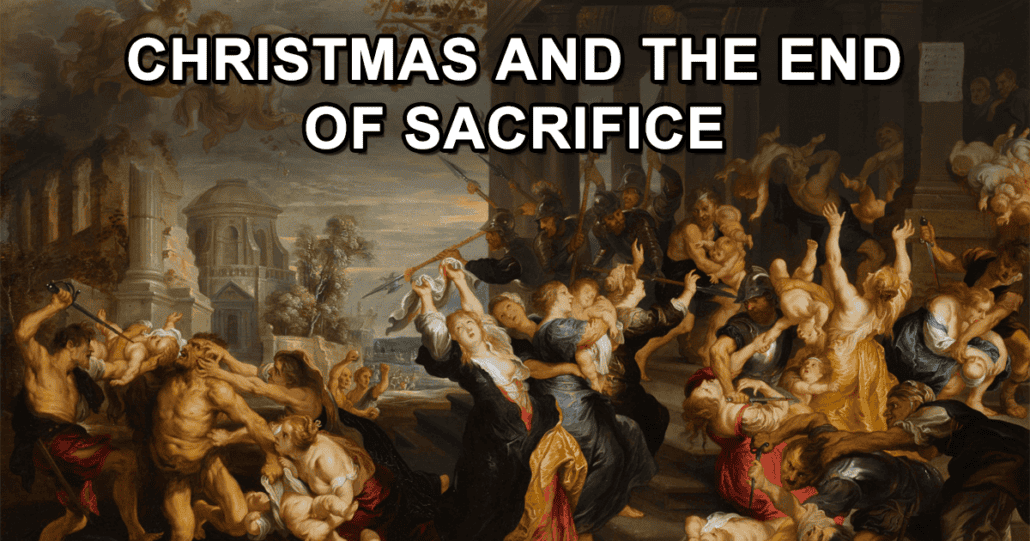
The Christian faith often invites us to hold together texts and events that seem to resist harmony. Nowhere is this tension felt more sharply than in the contrast between the Old Testament’s harsh legal judgments and the New Testament’s radical call to non-violence. As we approach the Christmas season and contemplate the Nativity of Christ, the tender scene of the infant Jesus in a manger is shadowed by one of Scripture’s darkest narratives: the massacre of the innocents. The Gospel writers present this tragedy with profound grief. Yet readers of the Hebrew Scriptures notice that similar tragedies in the age of the Old Covenant are often described with stark simplicity and without the lament that accompanies Herod’s violence. This contrast raises a deeply troubling question. Why is the death of innocents recognized as a source of sorrow after Christ’s birth, but often narrated with apparent indifference in earlier Scripture?
René Girard provides a powerful anthropological key that helps Christians understand this development without falling into despair or rejecting the Old Testament entirely. Girard argues that human societies were founded on sacrificial mechanisms. These mechanisms involved the collective murder or expulsion of a victim who was believed to bring peace to the community. Humanity learned to survive through violence long before it could conceive of surviving through mercy. Girard’s insight allows us to read Scripture not as a static portrait of God’s will but as a story of God entering human history to guide a violent people toward a new way of being.
Seen through this lens, the severity of certain Old Testament laws does not reveal a cruel deity but the pastoral strategy of a God who begins with a humanity shaped by sacrificial logic and gradually leads it toward the fullness of love revealed in Christ. Numbers 16 provides an unsettling example. A man who gathers sticks on the Sabbath is executed by stoning at the command of God. In a purely literal reading, this appears irreconcilable with the Jesus who heals on the Sabbath before large crowds and defends his actions with confidence and compassion. There is no simple way to flatten these two revelations into one static moral code. The only coherent explanation is that God patiently descends into human cultural forms and begins to reshape them from within. Divine revelation does not erase human violence in a single stroke. It slowly exposes it.
Girard teaches that the Bible is the only ancient literature that consistently reveals the innocence of the victim. Early texts still speak in the idiom of sacrificial societies, yet even there the structure begins to weaken. The cry of the prophets against injustice, the psalms that plead for mercy, and the story of Israel as a people rescued from slavery all work together to prepare the way for a world that can recognize the victim rather than scapegoat them. The lack of lament in some early narratives reflects not divine indifference but human blindness. Scripture does not hide this blindness. It records it so that we may witness its gradual healing.
The massacre of the innocents in Matthew’s Gospel marks a turning point. The text grieves the murdered children and ties their suffering to the prophetic lament of Rachel who weeps for her offspring. Here Scripture places the suffering of the victim at the center of salvation history. Herod’s violence is no longer narrated with composure. It is exposed as the same scapegoating impulse that fuels every violent society. This revelation reaches its climax in the passion of Christ, where the crucified one is shown to be completely innocent and utterly non-violent. In his Sermon on the Mount, Jesus declares that retaliation must end. His teaching to turn the other cheek offers a new anthropology. It replaces reciprocity of harm with a refusal to participate in the cycle of vengeance.
If we reject this developmental view of revelation, we are left with an impossible choice. Either we embrace a God who commands slaughter and also commands mercy, which results in a Janus-faced deity, or we resolve the tension by discarding the Old Testament and drifting into Marcionism. Many Christians, lacking an anthropology that explains the Bible’s inner movement, attempt to balance incompatible images of God and end up with a confused theology of violence and innocence. Some believe God defends unborn life while endorsing the destruction of children abroad. Others come to the opposite conclusion. Both positions arise when the sacrificial lens of ancient society is not understood.
Girard’s anthropology should be considered an essential tool for modern Christians. It shows how God worked within the limitations of human culture and how revelation slowly unveiled the truth about violence. The God who seems severe in early Scripture is the same God who appears in the Christmas manger. The difference lies in humanity’s ability to perceive the innocence of victims and to recognize that God stands with those who suffer. Through the prophets and ultimately through Christ, God leads humanity away from a world where peace is secured by sacrifice and toward a kingdom where peace is secured by love.
The arc of Scripture reveals a divine pedagogy. God begins with a world steeped in violence and gradually transforms it from within. In Christ, the sacrificial mechanism is exposed and overthrown. What begins in the shadows of ancient ritual ends in the light of the resurrection. God’s work through history is not the imposition of violence but the patient guidance of humanity toward an existence rooted in mercy, forgiveness, and the absolute value of every human life. The call to turn the other cheek is not merely a moral instruction. It is the culmination of a long journey by which God brings humanity out of the age of sacrifice and into the new creation inaugurated by Christ.
Read more by Surit Dasgupta here.









Leave a Reply
Want to join the discussion?Feel free to contribute!