
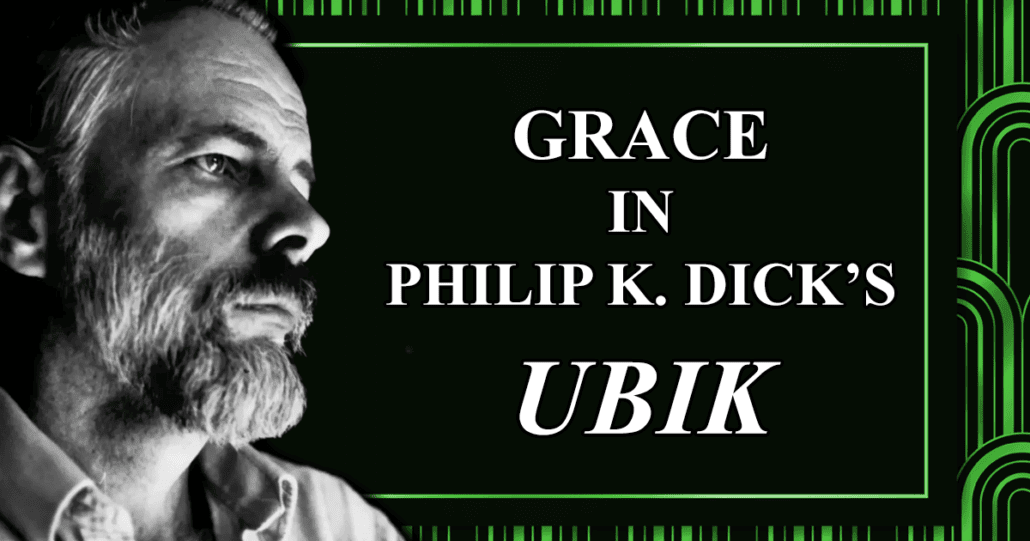
Grace in Philip K Dick’s “Ubik”
Among the great American novelists of the twentieth century, few have proven more prophetic than Philip K Dick. His novels are often shelved under science fiction, yet that label obscures the deeper nature of his work. Dick was not merely interested in futuristic gadgets or speculative worlds. He was concerned with metaphysics, memory, identity, death, and the terrifying instability of reality itself. His fiction stands at the crossroads of theology, paranoia, and philosophy. In an age dominated by digital simulation, algorithmic manipulation, and fractured truth, his work feels less like fiction than revelation.
Among his many novels, “Ubik“ remains perhaps his most haunting achievement. It is a novel that dissolves the boundary between life and death, between illusion and truth, between the sacred and the commercial. It is also one of the most spiritually unsettling books ever written in modern American literature.
The world of “Ubik” is unstable from the very beginning. Reality deteriorates in increments. Objects regress into older forms. Cigarettes turn stale. Modern appliances become relics. Coins disappear. Characters become uncertain whether they are alive, dead, dreaming, or trapped within someone else’s perception. Dick creates a universe in which the fabric of reality is not fixed but fragile, contingent, and manipulable.
This vision has become uncannily relevant in the twenty-first century. The social-media age has produced a culture in which reality is increasingly mediated through screens, curated identities, and algorithmic feeds. Truth no longer appears as something stable and universally shared. Instead, it fractures into personalized realities. Every individual inhabits a separate informational world shaped by outrage cycles, manufactured narratives, and emotional stimulation. Dick foresaw a civilization in which people would no longer know whether their perceptions corresponded to reality itself or merely to systems of manipulation operating behind the scenes.
What makes Dick especially important is that he understood this condition not merely as political or technological, but spiritual. In “Ubik”, unreality is not simply confusion. It is entropy. The world decays because human beings have become detached from transcendent truth. Reality itself begins to rot. Dick repeatedly suggests that falsehood is parasitic. It consumes and degrades being. One could say that his fiction presents evil not as dramatic villainy but as ontological corrosion.
This becomes especially poignant through the novel’s concept of “half-life.” In “Ubik”, the dead are not fully dead. Through cryonic preservation, they continue to exist in a suspended state where communication with the living remains possible for a limited period. The deceased inhabit a twilight realm between consciousness and dissolution. The protagonist, Joe Chip, gradually discovers that he and others may themselves already be trapped within such a condition.
The brilliance of this concept lies in how emotionally recognizable it is. Dick transforms grief into metaphysics. The dead do not disappear immediately from human life. They linger in memory, dreams, habits, photographs, voice recordings, and now digital archives. Modern technology increasingly creates forms of artificial persistence. Social media accounts remain active after death. AI models can reproduce voices and personalities. The dead continue speaking through data.
Dick intuited this long before the digital era emerged. “Ubik” asks a disturbing question: what happens when humanity gains the technological ability to indefinitely preserve fragments of consciousness? The novel suggests that such preservation may not bring comfort but existential confusion. Half-life becomes a metaphor for humanity’s inability to let go, as well as its refusal to confront mortality honestly.
Yet Dick is not mocking grief. On the contrary, “Ubik” is filled with tenderness toward the dead and toward the loneliness of the living. The tragedy of the novel is that modern civilization attempts to mechanize transcendence without understanding it spiritually. Human beings seek immortality through technological extension rather than spiritual transformation. They attempt to preserve consciousness while losing the sacred framework that once gave death meaning.
This tension culminates in the mysterious substance known as Ubik itself. Throughout the novel, Ubik appears in different forms: spray cans, commercial advertisements, consumer products, and corporate slogans. It is marketed like a household commodity, yet gradually reveals itself as something transcendent, perhaps even divine. Ubik preserves reality from decay. It acts as a stabilizing force against entropy and illusion. In one of the novel’s final revelations, Ubik speaks in explicitly theological language, describing itself as eternal and omnipresent.
Dick’s genius lies in presenting grace through the imagery of advertising. Ubik resembles God transformed into a commercial product. Salvation arrives not through liturgy or revelation, but through branded packaging and marketing language. This is simultaneously absurd, comic, and deeply tragic.
The novel therefore becomes a profound critique of modern desacralization. In a consumer civilization, even transcendence becomes commodified. Religion itself risks becoming another product within the marketplace of identities and experiences. Churches compete for attention through branding strategies, emotional spectacle, and self-help rhetoric. Spirituality becomes therapeutic consumption rather than confrontation with ultimate reality.
Dick understood that capitalism possesses a nearly limitless ability to absorb the sacred into the machinery of commerce. The terrifying aspect of “Ubik” is that the characters barely notice this transformation. They accept it instinctively. Grace arrives as a purchasable item because they no longer possess the symbolic imagination necessary to recognize holiness outside commercial forms.
This insight feels extraordinarily relevant today. Contemporary religious culture often mirrors the logic of entertainment platforms and advertising ecosystems. Faith risks becoming optimized for engagement metrics rather than truth. The transcendent is flattened into content. In such an environment, God becomes less a mystery to be encountered than a product to be consumed.
And yet “Ubik” does not descend into nihilism. Dick’s work is paranoid, fractured, and unstable, but beneath it lies a desperate longing for transcendence. Unlike many modern writers who treat reality as meaningless flux, Dick believed there was something real beyond illusion. The tragedy is that human beings can no longer perceive it clearly.
His novels repeatedly suggest that reality is layered. Beneath appearances there exists a hidden order struggling to break through the noise of manipulation, decay, and false consciousness. Dick’s characters are often damaged, confused, and morally compromised, yet they continue searching for authentic reality. This search itself becomes sacred.
What makes Philip K. Dick indispensable today is precisely this fusion of metaphysical anxiety and spiritual hunger. He anticipated the collapse of shared reality long before the internet. He foresaw the psychological fragmentation produced by media saturation. He predicted the commercialization of identity and transcendence. But he also perceived humanity’s enduring longing for grace beneath the machinery of modern life.
In the end, “Ubik” remains one of the great religious novels of modernity, though it disguises itself as science fiction. It confronts readers with unsettling possibilities: that reality may be fragile, that death may no longer remain fully separate from life, that commerce may absorb the sacred, and that truth itself may be dissolving beneath systems of simulation.
Yet Dick leaves open the possibility that transcendence persists despite everything. Even in worlds of decay and illusion, there remains the faint suggestion of a reality more fundamental than appearances. His work reminds us that the deepest human task is not merely to survive technological civilization, but to discern what is real within it.
Read more essays by Surit Dasgupta here.
Buy Dasgupta’s novella here.






Leave a Reply
Want to join the discussion?Feel free to contribute!