
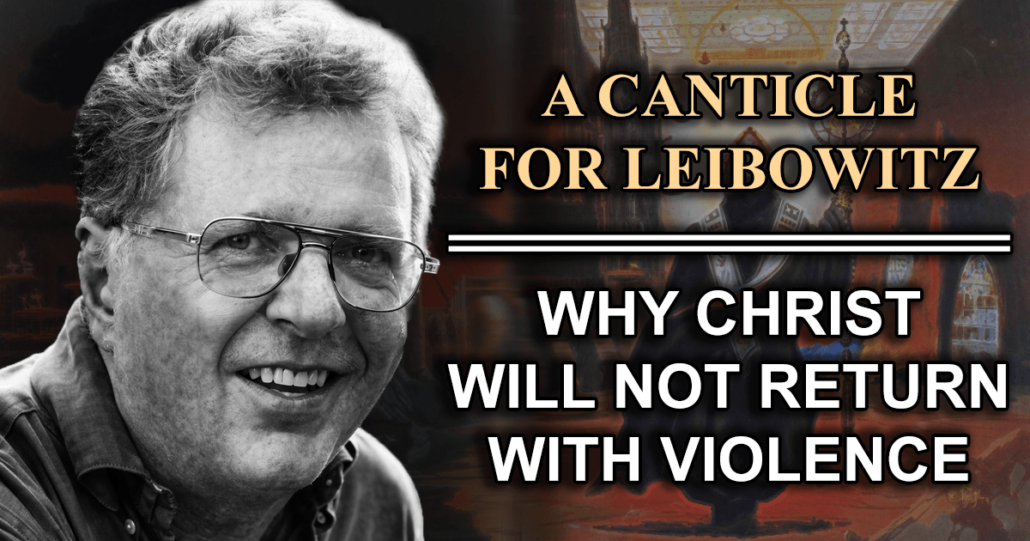
A Canticle for Leibowitz – Endless Armageddon
Those who seek to hasten the return of Christ (or the first advent of a messiah) through war would do well to reflect on “A Canticle for Leibowitz,” the haunting work of Walter M. Miller Jr.. Far from presenting catastrophe as a prelude to divine renewal, Miller’s novel offers a sobering vision of history caught in repetition, where destruction yields not redemption but amnesia, regression, and renewed violence.
Set in a post-apocalyptic future following a nuclear holocaust known as the “Flame Deluge,” the novel traces centuries of human recovery through the quiet endurance of a monastic order dedicated to preserving fragments of scientific knowledge. These monks, heirs to the medieval legacy of the Catholic Church, safeguard texts and relics from the lost world, often without understanding their full meaning. Their task is not merely archival. It is moral and theological. They must decide whether humanity, having once annihilated itself through technological pride and violence, is fit to reclaim what it has lost.
Miller’s own experience as a bombardier in World War II, particularly his involvement in the destruction of an ancient monastery in Monte Cassino, profoundly shaped the novel’s moral imagination. Scholars of the text often note that the abbey in the novel mirrors the historical Monte Cassino Abbey, whose bombing left a lasting psychological imprint on Miller. This biographical context helps explain the novel’s deep ambivalence toward progress. Scientific knowledge is not rejected outright, but it is treated with suspicion, as something that can either illuminate or destroy depending on the moral state of its bearers.
The narrative of “A Canticle for Leibowitz” unfolds across three distinct eras, each representing a stage of civilizational recovery. Yet each stage also contains the seeds of its own undoing. As knowledge returns, so too does the capacity for large-scale violence. The invention of an electrical generator brings fascination, but the rediscovery of the nuclear bomb brings fear. By the novel’s conclusion, humanity stands once again on the brink of nuclear annihilation. The monks’ fears are vindicated. History, it seems, has not progressed but merely repeated itself.
This cyclical vision aligns closely with the anthropological insights of René Girard, whose theory of mimetic desire and scapegoating provides a powerful framework for understanding the persistence of violence. Girard argues that human beings imitate one another’s desires, leading inevitably to rivalry and conflict. Societies manage this tension through scapegoating, projecting violence onto a chosen victim in order to restore temporary peace. However, this mechanism is built on a lie, the false belief that the victim is truly guilty and that their elimination brings justice.
In a Girardian reading of the Book of Revelation, its apocalyptic imagery does not simply foretell future events. It presents two possible destinies for humanity. The first is the collapse of all distinctions and the unchecked escalation of violence. The second is the renunciation of violence, the triumph of the Lamb, and the coming of the New Jerusalem. In simpler terms, humanity stands before a choice between self-destruction and total transformation through Christ.
Miller’s novel can be read as a narrative embodiment of this Girardian insight. The world of “A Canticle for Leibowitz” does not end because of divine judgment alone. It ends because humanity refuses to abandon its destructive patterns. God’s judgment here is that there will not be a “New Jerusalem,” just a return to the fall—a “reset,” if you will. Even after near extinction, people return to tribalism, warfare, and the pursuit of domination. The preservation of knowledge by the monks stands as a fragile hope, but it is not enough to break the cycle. Without moral transformation, knowledge becomes once again an instrument of annihilation.
This interpretation challenges popular apocalyptic fantasies that imagine war as an acceleration towards divine intervention. Both Miller and Girard suggest that such thinking is not only misguided but dangerous. It externalizes responsibility and sanctifies violence under the guise of faith. In contrast, the Christian message, as properly understood, calls for the rejection of violence at its root. It demands the recognition of the other not as an enemy or potential scapegoat, but as a neighbor.
In this light, the true warning of “A Canticle for Leibowitz” is not about nuclear war alone. It is about the deeper patterns that make such wars possible. The novel asks whether humanity can learn from its own history or whether it is doomed to repeat it indefinitely. The answer, it suggests, depends not on technological progress or political power, but on the willingness to renounce the logic of violence itself.
Read more of Surit Dasgupta’s essays here.







Leave a Reply
Want to join the discussion?Feel free to contribute!