
How the American Left Harms Palestinians
In recent years the alliance of left-wing activism and the Democratic establishment has in many ways undermined the Palestinian cause rather than advancing it. Several contradictions are now impossible to ignore: the liberal Left’s secular worldview versus the traditional, religious social fabric of Palestinian society; the performative activism that generates moral noise but little political change; and the reliance on Democratic politicians who loudly champion progressivism domestically while maintaining robust support for Israel abroad.
The contradiction embodied in U.S. progressive influencers
The disconnect is stark when examining prominent left-leaning personalities like the streamer Destiny, who champions LGBTQ rights, women’s rights, and progressive domestic policy, yet consistently defends Israel’s military campaign in Gaza even as a wide range of human-rights groups, UN officials, and international observers describe that campaign as indiscriminate or “genocidal.” Destiny’s position illustrates the deeper contradiction of the American Left: a belief that one can embody victim-garbed progressivism at home while backing a violently oppressive foreign policy abroad.
Performative activism and its empty symbolism
This tension is further illustrated by moments of spectacle, such as Hannah Einbinder’s Emmy-stage sign-off: “Go Birds, f*** ICE, and free Palestine.” While intended as support, her statement treated Palestine as a cultural accessory — part of a bundle of progressive slogans rather than a distinct national struggle. The Palestinian cause becomes a symbolic prop within a U.S. moral landscape, detached from the lived realities of occupation, siege, and displacement.
Democrats’ rhetoric vs. their actual policies
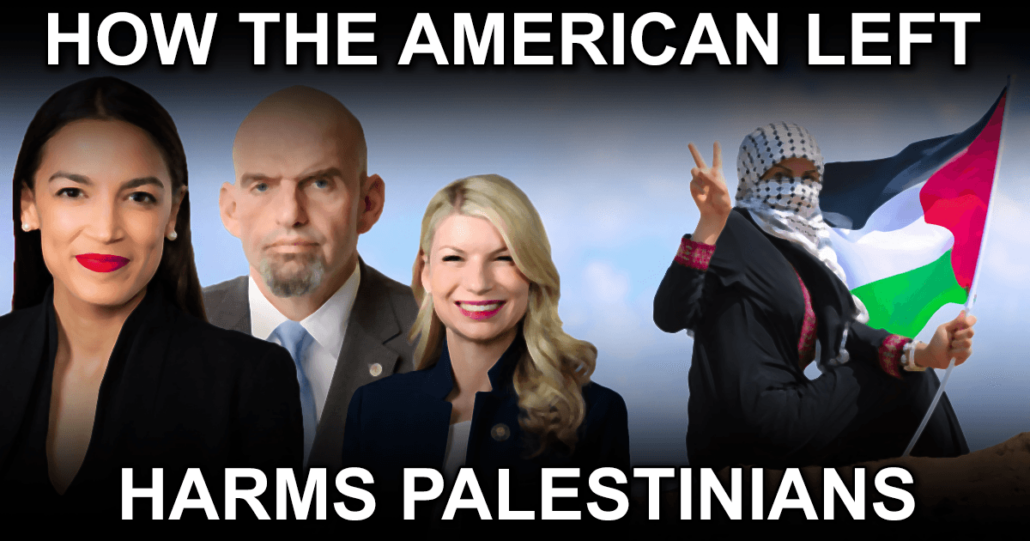
The pattern extends into Democratic politics. Progressive lawmakers like AOC often express sympathy for Palestinians, yet their voting records complicate the narrative. AOC publicly condemned Israel’s campaign as an “unfolding genocide,” but then voted against an amendment that would have cut funding for Israel’s Iron Dome missile-defense system. She is not alone. Other Democrat representatives like Brittany Petterson from Colorado has done the same. This duality signals that progressive rhetoric does not necessarily translate into policy capable of protecting innocent Palestinian civilians.
Meanwhile, mainstream Democrats — the very leaders the Left supports — remain staunch allies of Israel. Hillary Clinton has long affirmed “unbreakable” U.S.–Israel ties, defending Israel even during controversial military operations. John Fetterman, once celebrated as a progressive outsider, now openly advocates unconditional aid to Israel and dismisses any criticism of the state’s actions as out-of-bounds. These positions are not peripheral—they reflect the dominant Democratic foreign-policy consensus.
The result is a glaring contradiction: the American Left elects leaders who deliver progressive messaging at home while reinforcing the strategic status quo abroad. For Palestinians, this means they receive solidarity speeches but not relief from the political machinery enabling their suffering.
The cultural mismatch
The American Left’s activism is grounded in secularism, queer theory, anti-colonial identity politics, and individualism. Palestinian society, however, is rooted in traditional religious life, family structures, communal identity, and cultural conservatism. When activists graft their own ideological frameworks onto Palestine, they risk misrepresenting Palestinian values and eroding support from Arab, Muslim, and socially conservative communities worldwide.
What this disconnect produces
The forced alliance between Palestinians and radical leftism has produced four major harms:
1. Symbolic gestures instead of substantive strategy, exemplified by entertainment-industry sloganeering.
2. Dependence on Democrats, who empathize rhetorically but uphold the U.S.–Israel strategic relationship.
3. Cultural misalignment, where U.S. leftist ideology erases Palestinian agency and traditions.
4. Confusion in messaging, where commentators like Destiny champion progressive ethics at home while defending Israeli actions that many international observers condemn.
An anthropological perspective
From the lens of Rene Girard’s mimetic theory, segments of American left-wing activism around Palestine fall into mimetic rivalry—a competition to appear the most radical or morally pure. In this cycle, Palestine becomes a symbolic object in Western ideological battles rather than a real people with concrete political needs. As rhetoric escalates for in-group validation, Palestinians risk being turned into sacrificial figures whose suffering is invoked to resolve Western conflicts, not to advance Palestinian agency.
Girard would also note that such mimetic movements often create scapegoats. Palestinians who voice moderate, pragmatic, or locally grounded views may be sidelined or condemned for failing to match Western activists’ ideological expectations. In this process, solidarity becomes more about maintaining Western group identity than listening to Palestinians themselves, ultimately harming the diversity, strategy, and effectiveness of the Palestinian cause.
Conclusion
The Palestinian cause suffers when its narrative is filtered through Western ideological categories and tied to a Democratic political elite unwilling to challenge the U.S.–Israel alliance. For Palestinians to advance their own national project, they need independent leadership, broader coalitions, and a liberation movement grounded in Palestinian values — not a borrowed identity-politics script that contradicts itself at every turn.
Read more by Surit Dasgupta here.









Leave a Reply
Want to join the discussion?Feel free to contribute!