
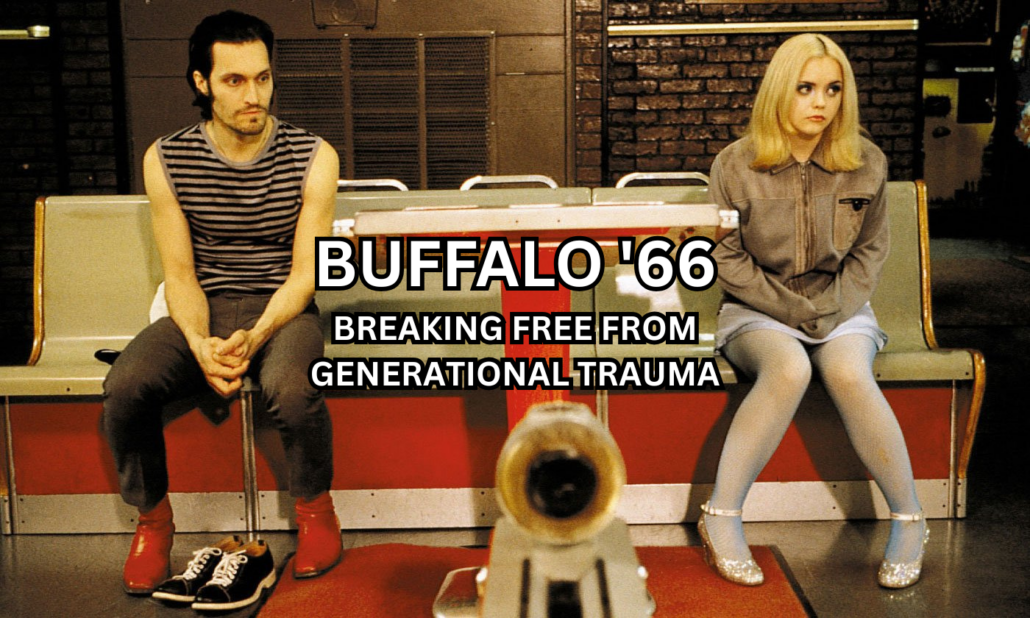
How Buffalo ’66 Shows Us We Don’t Have to Carry Generational Trauma
Vincent Gallo’s 1998 film Buffalo ’66 is an offbeat indie film about a man stumbling through life after prison. Directed by Vincent Gallo, the film is notorious for its behind the scenes difficulties, most notably the rift between its two lead actors, which is ironic because the message is redemption through denial of victimhood and taking responsibility, as Gallo puts it.
Beneath its gorgeous color palette and sardonic humor, Buffalo ’66 carries a deeper message about breaking the cycle of generational trauma. Through the character of Billy Brown (Gallo) and his forced, then unexpectedly redemptive, relationship with Layla (Christina Ricci), the film shows that while trauma may shape us, it does not have to define us. We have the power to confront it, reject it, and move forward.
Billy Brown is introduced to us as a tightly wound, socially maladjusted man just released from prison. Never smiling and often complaining, we realize that Billy is probably the most unlikable character put on celluloid. His first act of freedom is to kidnap a stranger—Layla—and force her to pretend to be his wife in front of his parents. This act isn’t about power or cruelty so much as it is about desperately seeking validation. Billy is trying to uphold a fantasy in front of his emotionally abusive and neglectful parents. From the moment we meet them, it becomes clear where Billy’s damage comes from. His mother is obsessed with football, oblivious to her son’s pain or even his incarceration. His father is cold, awkward, and emotionally distant. Their home is a shrine to disappointment and unmet expectations.
Gallo paints this dynamic not with melodrama, but with brutal realism. It is not a singular act of violence that haunts Billy, but the slow, cumulative weight of being unloved. This is a portrait of generational trauma—not just inherited pain, but a deep failure of emotional connection. Billy has internalized the neglect and rejection of his upbringing, and his self-worth has been ground down to nothing.
Yet, Buffalo ’66 does not wallow in this trauma. Instead, it opens a small but significant window of possibility. That window is Layla.
Layla, played with quiet vulnerability by Christina Ricci, is at first a victim of circumstance. But she doesn’t act like one. Rather than recoil from Billy’s awkwardness and anger, she chooses to see him. Layla brings gentleness into Billy’s brutal, loveless world. She listens. She dances. She challenges his assumptions without humiliating him. To the audience, she represents the importance of being kind and loving—even to those who would wish us harm. Through her patience and affection, she represents the possibility of a different kind of relationship—one based not on fear or shame, but on mutual care.
The turning point comes when Billy, having plotted to kill the man he blames for ruining his life, hesitates. We’re given a stylized fantasy sequence in which he commits the murder and kills himself afterward—a vision of what trauma tells him is inevitable. But then he stops. He chooses not to follow through. He goes back to Layla. In this small but radical act, Billy breaks the chain. He chooses life. He chooses love. He chooses something outside of what he was given.
This is what makes Buffalo ’66 so powerful. It acknowledges that trauma is real, deep, and inherited—but it also insists that it’s not destiny. Billy’s parents are emotionally frozen, locked into their own dysfunction. But Billy doesn’t have to be. Layla offers a model of care he never received, and in choosing to be with her, he begins to rewrite his story.
The film does not end with a sweeping resolution or a grand gesture. Instead, it ends with a simple, tender moment: Billy bringing Layla a hot chocolate, a small but meaningful act of kindness. It’s not about solving everything. It’s about beginning something new.
What is the purpose of great and authentic art? For existential philosopher Nikolai Berdyaev, art is about preparing the world for the coming Kingdom of God. Given the rise of pain and suffering, especially in modern families, Buffalo ’66 is an example of art doing just that.









Leave a Reply
Want to join the discussion?Feel free to contribute!