
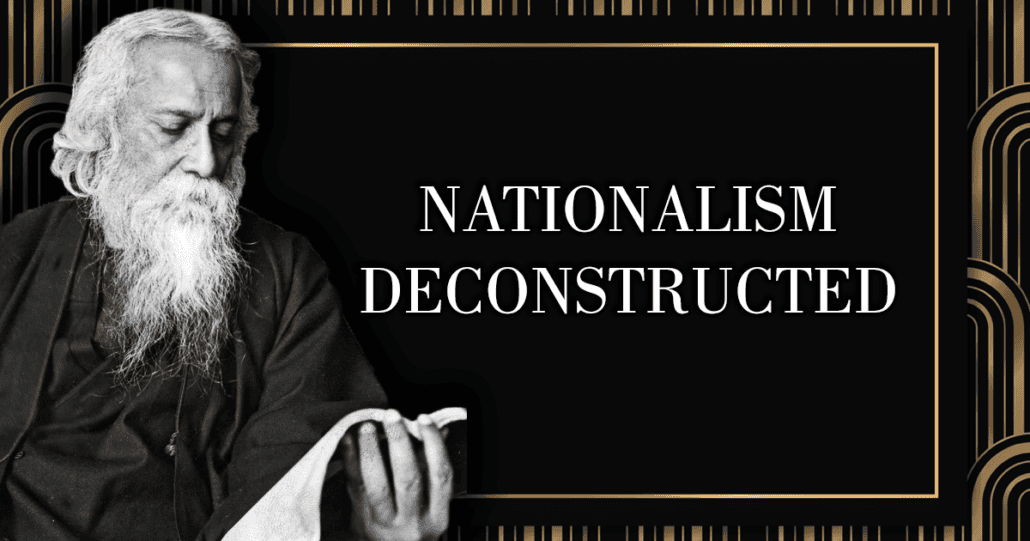
Gora – An Indian Deconstruction of Nationalism
Rabindranath Tagore’s impact on Indian literature cannot be overstated. At a time when nationalism was blazing across continents, often hardening into violent exclusion and mass mobilization, Tagore articulated a vision that transcended tribal boundaries and elevated the dignity of the human person. While Europe descended into xenophobia, war, and racial persecution, India embarked on a restless and uncertain search for self-definition in an increasingly mechanized and homogenized world. This search produced a remarkable explosion of movements, each led by figures of intense conviction and experimental imagination. It was an era marked not only by turbulence and contradiction, but also by hope and moral courage. Nowhere is the spirit of that moment captured more vividly than in Tagore’s extraordinary novel Gora.
The late nineteenth and early twentieth centuries witnessed the gradual embedding of national identity into the Indian psyche. Nationalism spread rapidly, fueled by colonial domination and the desire for political self-rule. Revolutionary figures began to emerge alongside competing and often incompatible visions for India’s future. For Bhagat Singh and his comrades, communism offered the promise of liberation through radical equality. For V. D. Savarkar, freedom without the revival of Hindu orthodoxy and civilizational pride was inconceivable. For Mahatma Gandhi, ahimsa, understood as cosmic and active nonviolence, formed the moral core of Indian identity. Religion itself did not escape this atmosphere of experimentation. Reformist ideas circulated widely among India’s educated classes, particularly within Bengal’s Hindu intelligentsia.
It was in this context that the Brahmo Samaj emerged. This reform movement rejected idol worship, ritualism, caste hierarchy, and polytheism, advocating instead a rational, ethical, and monotheistic faith influenced by Enlightenment thought and Protestant Christianity. Tagore’s family was deeply associated with the Brahmo Samaj, and its ideals left a lasting imprint on his intellectual and artistic sensibility. Yet Tagore never became a propagandist for reform. Rather, he remained deeply suspicious of all systems that reduced human beings to abstractions, including progressive ones.
The rise of the Brahmo Samaj was, in many ways, an inevitable reaction against a Hindu orthodoxy that had doubled down on rigid caste distinctions and social exclusion. This tension produced a rivalry between reformists and Hindu nationalists, a rivalry that continues in various forms in contemporary India. Tagore, however, did not see this conflict as productive for a civilization as plural and layered as India’s. In Gora, he stages this rivalry not as a polemic but as a moral inquiry.
The novel’s narrative structure is crucial to its philosophical depth. Tagore shifts perspective between the reformist Brahmo Samaj household and the Hindu nationalist worldview embodied by the novel’s protagonist, Gora. This allows him to test each position through lived dilemmas rather than abstract arguments. How would a sincere Hindu orthodox respond to injustice inflicted upon impoverished Muslims? Would a progressive Brahmo Samaj parent allow their daughter the freedom to reject reformist beliefs and choose a more traditional religious life? These questions are not rhetorical traps. They are genuine moral challenges posed to both sides.
This dialectical method is rare, not only in Indian literature but also in the Western canon. Many Western authors, whether liberal or conservative, tend to immunize their own worldviews from scrutiny. Tagore does not grant himself that luxury. His reformists can be morally earnest yet emotionally detached, while his orthodox nationalists can be courageous and sincere yet blind to the violence implicit in exclusion. No ideological camp emerges unscathed.
At the center of the novel stands Gora himself, a towering figure of moral seriousness and uncompromising nationalism. Gora is not a casual patriot. He is a militant believer in the idea that Hindu society must purify and strengthen itself if India is to survive colonial domination. He defends caste discipline as a necessary social structure, insisting that cohesion requires boundaries. He rebukes Hindus who associate too freely with Muslims or Christians, not out of personal hatred, but because he believes such openness weakens the moral spine of the nation. He is particularly hostile toward the Brahmo Samaj, whom he accuses of importing Western ideas that dissolve India’s spiritual core.
Yet Tagore refuses to caricature Gora as a fanatic. Gora’s nationalism is animated by moral seriousness, not cruelty. He intervenes forcefully when Muslims are mistreated, even when doing so places him at odds with his own community. He despises cowardice, opportunism, and hypocrisy. When orthodox Hindus exploit religion to justify comfort or dominance, Gora confronts them with equal severity. Again and again, his ethical instincts outrun the ideological boundaries he has imposed upon himself.
The tragic tension of Gora’s character lies precisely here. He believes identity is sacred and inherited, yet his conscience responds instinctively to suffering wherever it appears. His nationalism demands hierarchy, but his moral intuition gravitates toward universal dignity. This unresolved contradiction drives the novel forward.
Running quietly beneath Gora’s ideological fervor is a far more radical moral witness. This witness is his mother. Unlike Gora, she is not a nationalist, reformer, or philosopher. She is a woman shaped by Hindu orthodoxy, ritual observance, and social expectation. Yet she carries within her a secret that places her at the moral center of the novel. She knows that Gora is not Hindu by birth. He is the orphaned son of Irish parents, adopted during the violence of the 1857 uprising, when his parents were killed and he was left abandoned.
Her response to this knowledge is neither reformist rebellion nor orthodox defensiveness. It is sacrifice.
Gora’s mother chooses to live a life of quiet contradiction. She outwardly maintains the forms of Hindu orthodoxy, knowing that society demands it. But inwardly, she has already crossed a boundary that nationalism and caste ideology insist must never be crossed. She loves a child who, by every criterion of blood, caste, and religious inheritance, should be excluded. She raises him as her own, fully aware that the truth, if revealed, would destroy both his social standing and the ideological world he inhabits.
This choice extracts a profound cost. She bears the loneliness of secrecy and the pain of watching her son become a fierce defender of an identity that would reject him without hesitation. Her maternal love places her beyond both orthodoxy and reform. She neither publicly renounces tradition nor absolutizes it privately. Instead, compassion slowly hollows out orthodoxy from within.
The irony deepens when the reader reflects on Gora’s name. “Gora” in Bengali and Hindi literally means “fair-skinned” or “white.” It is a name often associated with Europeans. To Indian readers, this carries an immediate irony. To Western readers, it becomes clear only later that the name functions as a literary prophecy. Gora, the most strident defender of Hindu nationalism in the novel, is quite literally a foreigner by blood. Tagore embeds this irony from the outset, allowing the reader to sense a tension between appearance, identity, and truth long before it is revealed to the protagonist himself.
The revelation of Gora’s origin does not arrive abruptly or casually. It emerges through a slow unraveling of circumstances and confessions, culminating in the disclosure by his mother, who can no longer bear the moral weight of silence. When Gora learns the truth, the effect is devastating. The foundation of his self-understanding collapses. If Hindu identity is inherited, then he has no claim to it. If nationalism rests on blood and continuity, then he is an intruder.
Yet Tagore refuses to let this discovery end in nihilism. What saves Gora from despair is not the adoption of a new ideology, but the recognition of a moral truth that had surrounded him all along. His mother’s life stands as a living refutation of exclusionary identity. She had already resolved the problem of nationalism through love. She had chosen the human person over the abstraction of purity.
Freed from the need to defend a rigid conception of national or religious identity, Gora arrives at a more expansive understanding of India. India, he realizes, cannot be defined by ancestry, ritual conformity, or ideological uniformity. It must be grounded in ethical responsibility and compassion. The nation exists for people, not people for the nation.
In this resolution, Tagore offers a profound deconstruction of nationalism without lapsing into rootless cosmopolitanism. He does not deny the importance of tradition or cultural continuity. Instead, he reorders them. Tradition must answer to compassion. Identity must yield to truth. National pride must bow before human dignity.
For Western readers, Gora offers an alternative genealogy of modern moral thought. It demonstrates that critiques of nationalism, identity politics, and ideological absolutism did not emerge solely from Europe’s twentieth-century catastrophes. They were articulated simultaneously within colonized societies wrestling with their own ethical futures. Tagore anticipated the moral failures of modern nationalism not through abstract theory, but through narrative empathy and lived contradiction.
In the end, Gora uplifts human personhood by insisting that no ideology, whether traditionalist or progressive, has the right to eclipse the irreducible dignity of the individual. The novel’s deepest wisdom does not emerge from political programs or reformist manifestos, but from a mother’s willingness to love across forbidden boundaries. In that quiet act of compassion, Tagore locates the true soul of India, and perhaps the only nationalism worthy of the name.
Read more essays by Surit Dasgupta here.
Buy Surit’s novella The Reenchanted here.









Leave a Reply
Want to join the discussion?Feel free to contribute!