
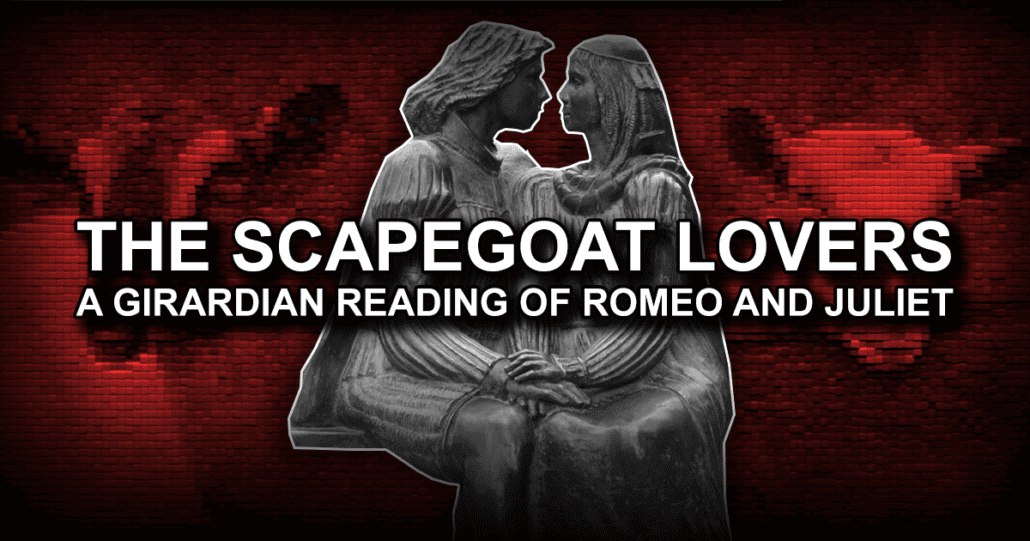
Romeo and Juliet as Scapegoat Lovers: A Girardian Analysis
René Girard’s mimetic theory, with its profound implications for literature, anthropology, and theology, casts a revelatory light on Shakespeare’s Romeo and Juliet. Often mistaken for a tale of tragic love, the play is, at its core, a violent ritual deconstructed, thus revealing the sacrificial machinery upon which society maintains its false peace.
In Girard’s framework, human desire is imitative; we want what others want, and this mimetic rivalry spirals into collective violence. To contain this, societies unconsciously choose scapegoats–innocent victims–whose deaths momentarily restore order. Romeo and Juliet, like the Gerasene demoniac, are scapegoated to absorb the communal tension. Their deaths are not senseless accidents but deliberate expulsions, necessary offerings to maintain social order.
The feuding Montagues and Capulets are gripped in a mimetic rivalry so entrenched that even the original cause of their hatred is forgotten. What remains is a mechanical antagonism, sustained by honor and blood. Romeo and Juliet, by falling in love, transgress this binary. Though both of them are firmly gripped by romantic delusion, their love is revolutionary in the sense that it threatens to collapse the illusion of the feud. Such subversion cannot be tolerated.
The system must reassert itself. As with Christ’s Passion, the city begins to conspire—not through plot, but through the inevitability of violence. Tybalt’s murder of Mercutio and Romeo’s retaliatory killing of Tybalt initiate a chain reaction. These acts are not isolated; they are symptoms of mimetic contagion. Everyone begins to mirror each other’s aggression, and the spiral accelerates. The civic order, represented by Prince Escalus, cannot restore peace through wisdom or justice. It requires blood. Romeo is banished. Juliet is coerced into a marriage with Paris. The sacrificial logic intensifies.
In this context, the lovers’ suicides resemble nothing less than a crucifixion. They are both innocent and necessary, not in the metaphysical sense, but in the eyes of the collective. Like the Gerasene demoniac, they take upon themselves the sins of the city. Their deaths bring an end to the feud, just as Golgotha, paradoxically, reconciles humanity. The Montagues and Capulets arrive at the tomb and suddenly awaken to their complicity. “See what a scourge is laid upon your hate,” says the Prince, echoing Pilate’s declaration: “Behold the man.” The recognition of their children’s innocence mirrors the moment the centurion confesses, “Truly this was the Son of God.”
But Shakespeare, like Girard, does not romanticize the resolution. The peace bought by Romeo and Juliet’s deaths is tainted. It exposes the moral bankruptcy of a society, which includes the deluded lovers, that requires sacrificial victims to maintain order. Girard insists that the Gospels uniquely unveil the scapegoat mechanism for what it is—unjust and unnecessary. In Romeo and Juliet, we are given a similar revelation. The play is not a call to weep for doomed lovers, but a mirror held to our own mechanisms of exclusion, rivalry, and violence.
Note that Shakespeare here performs a kind of cultural exorcism. The stage becomes a ritual space. The death of Romeo and Juliet is not redemptive in the transactional sense, but apocalyptic; it unmasks the truth. As with Girard’s reading of Christ, the lovers’ innocence forces us to confront our myths, our idols of honor and vengeance, and to ask: why must peace come through death?
In a world still governed by mimetic rivalries between nations, tribes, and ideologies, the tragedy of Romeo and Juliet resounds with unsettling familiarity. How many must die before we renounce the altar of collective violence? How many “martyrs” must bear the weight of our unresolved tensions? These are questions that bear relevance to what is unfolding in the ruins of Gaza, the meatgrinders in Ukraine, and the ghost towns of the American heartland.
Shakespeare, in his prophetic genius, anticipated Girard’s anthropology centuries before it was named. In Romeo and Juliet, we are not simply entertained; we are indicted. The play invites us to imagine a society beyond scapegoats—a kingdom not of vengeance but of mercy, not of imitation but of love that breaks the mimetic chain. Like the cross, the tomb in Verona not only buries, but it also reveals.
Read more essays by Surit Dasgupta here.








Leave a Reply
Want to join the discussion?Feel free to contribute!