
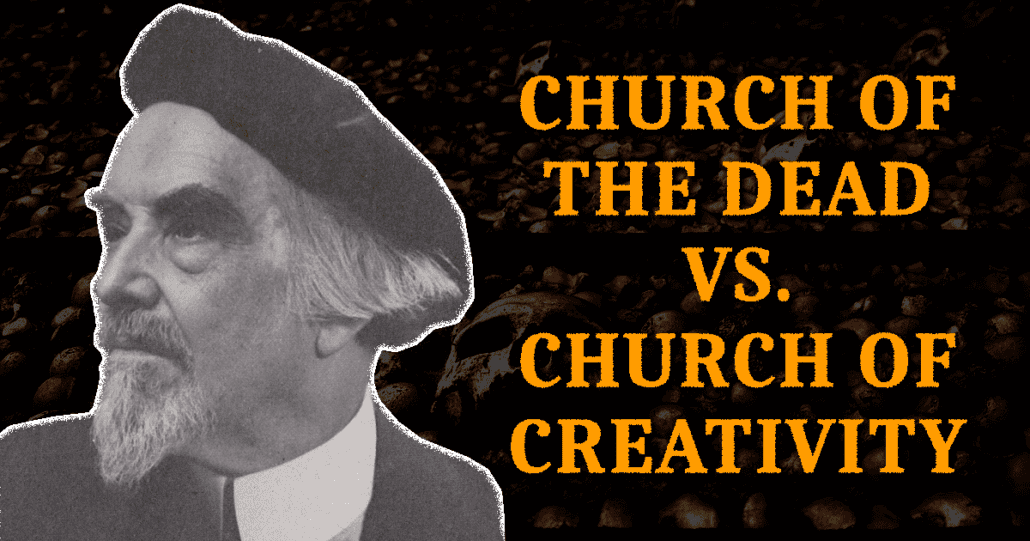
Berdyaev: Church of the Dead vs Church of Creativity
Nikolai Berdyaev’s philosophy of spirit, freedom, and creativity stands as one of the most striking attempts of the twentieth century to imagine a renewed Christianity. His religious existentialism is not an abandonment of the Christian tradition, nor is it a program to replace the Church with human self-assertion. Instead, it is an appeal to recover the true spiritual dynamic within Christianity, a dynamic that has too often been obscured by institutional rigidity, moral infantilization, and a fear of human creative freedom.
The Meaning of the Creative Act present Berdyaev’s most forceful indictment of what he calls the “sin against the Holy Spirit.” This sin occurs when the Church treats itself as final and complete, when it denies the ongoing work of the Spirit within history, and when it mistrusts creativity as a force that belongs to God’s own life. For Berdyaev, the Spirit is the principle of eternal newness, and any arrest of movement within the spiritual life indicates a withdrawal of the Spirit. A Church that ceases to be creative becomes a dead institution, protected by rules and habits rather than enlivened by divine freedom.
Berdyaev does not deny that the historic Church, what he calls the Church of Peter, had a necessary role. It provided guardianship for the spiritual childhood of humanity. It taught discipline, humility, and obedience. It preserved the sacred deposit of faith during the long centuries in which people lived under conditions of cultural and spiritual immaturity. Yet this guardianship created a deep boundary between God and the world. It taught believers to think of themselves as helpless creatures, forever dependent on external authority. It also encouraged a kind of religiosity rooted in fear, passivity, and spiritual childhood.
Modern humanity, Berdyaev argues, has reached a new stage. He does not claim that contemporary people are morally better than their predecessors. Instead, he believes that the human personality has matured. Human beings have experienced the heights and depths of culture. They have undergone the tragic pressures of freedom. They have learned that evil cannot always be understood as childish disobedience. The sins of the mature are more difficult, more paradoxical, and more internal. For that reason, the old answers of the Church of Peter no longer reach the deepest problems of modern consciousness.
This is the setting for Berdyaev’s call for a Johannine age. The Johannine Church is not democratic in the sense of accommodating itself to average spiritual capacities, nor is it authoritarian in the sense of imposing guardianship. It is mystical and spiritual. It is the Church that bears witness to the eternal life that Christ reveals. It is the Church that calls each person to ascend rather than descend, to cultivate inner depth rather than rely on external control. In this Church the central principle is freedom understood not as license but as creative participation in divine life.
Creativity, understood as the awakening of the full dignity of the person, resembles the parable of the shepherd who leaves the ninety nine in order to rescue the one who is lost. The shepherd’s act reveals that the individual carries an absolute and irreplaceable value that no collective measure can contain. In this light, the old Petrine Church of tutelage appears as a structure built to guard the flock as a whole, a necessary form of protection for an earlier stage of humanity. Yet such guardianship now belongs to an age that has passed. What matters today is the recognition that salvation occurs when the lost sheep is sought not because it serves the collective but because the person possesses a worth greater than any collective order. This is the same truth that underlies creative freedom. It directs us away from systems of control and toward an encounter with the human person as a source of divine possibility.
At the heart of Berdyaev’s thought is the conviction that the human being is created in the image of a creative God. According to him, God desires co-creators rather than servants. The highest religious act is therefore not submission but creative response. Submission has a place, yet it is preparatory rather than final. It trains the soul, but it must eventually be surpassed by what Berdyaev calls heroic creativity. This is the freedom that dares to act with God, to bear responsibility, and to participate in the transfiguration of the world.
This vision leads naturally to an eschatological orientation. Berdyaev believes that humanity is entering a creative epoch in which the final meaning of history will draw near. Such an epoch exposes all limits, illusions, and compromises. It demands that creativity address the whole of life rather than produce symbols alone. The distinction between culture and existence becomes thinner. Prophecy replaces clerical protection. The human element gains authority because it is precisely in the human that God desires to reveal divine freedom.
Eschatology, in Berdyaev’s sense, is not passive waiting for the end of the world. It is the active striving of mature persons who know that the kingdom of God is both a gift and a task. The Spirit calls the believer not to withdraw from history, but to enter more deeply into its creative possibilities. The coming of Christ is not only a future event but also an inner breakthrough that occurs when human beings rise to their full stature as creators. The apocalypse becomes a revelation of spiritual truth rather than a catastrophe viewed from afar.
Across his works, including The Destiny of Man and The Divine and the Human, Berdyaev remains consistent in his belief that the ultimate meaning of Christian life is the union of divine and human creativity. Christ does not come to restore humanity to a state of obedient childhood. Christ comes so that the human being may achieve spiritual adulthood. The Christian vocation is therefore not merely to obey but to create, to love truth actively, and to manifest in the world a freedom that reflects the infinite depth of God.
The challenge of Berdyaev’s vision is immense. It requires that Christians abandon reliance on the comfortable structures of everyday churchliness. It demands the courage to move beyond the safety of inherited forms, without rejecting the sacred reality they once preserved. It requires believers to confront the tragic dimensions of freedom and to accept responsibility for the world’s spiritual transformation. Yet Berdyaev insists that only through such heroic daring can Christianity renew itself and meet the deepest needs of modern humanity.
In calling for a new, creative Christianity, Berdyaev does not speak as a rebel against the faith. He speaks as someone convinced that the Spirit still works in history and that the mystery of Christ remains inexhaustible. His vision is a reminder that the Church is not a completed structure but a living organism. Its true life is not in external authority but in the interior freedom of persons who participate in the divine act of creation. For Berdyaev, this creative act is the meaning of human existence and the key to a renewed Christian world.
Read more essays by Surit Dasgupta here. Buy his novella The Reenchanted here.






Leave a Reply
Want to join the discussion?Feel free to contribute!