
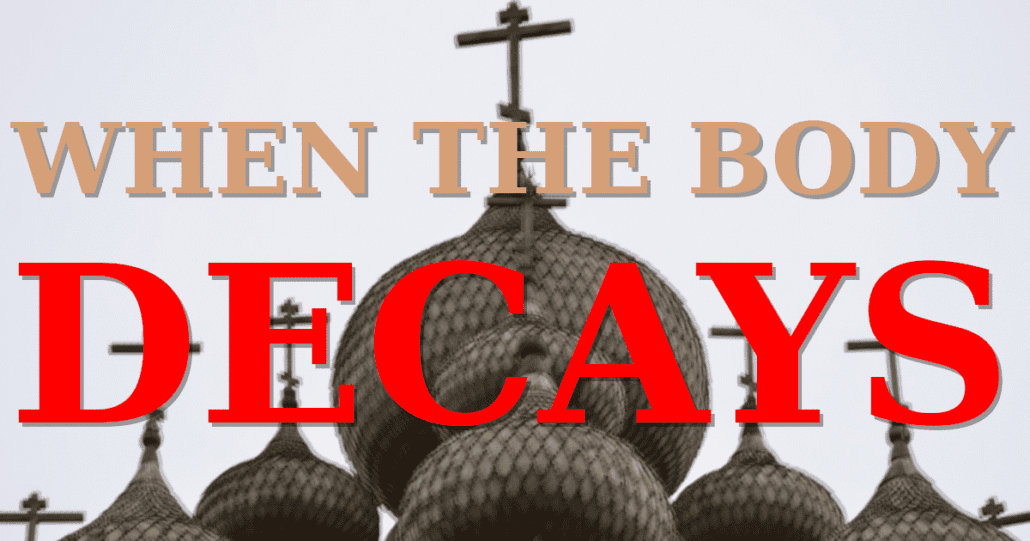
When the Body Decays: Dostoevsky, Elder Zosima, and the Triumph of Fear
The infamous chapter of “the Grand Inquisitor” in Fyodor Dostoevsky’s “The Brothers Karamazov” is rightfully praised as one of the great literary deconstructions of coercive institutional power. Ivan Karamazov’s parable presents a terrifying possibility: that human beings, unable to bear the freedom Christ gives them, will eventually prefer an institution that relieves them of the burden of freedom. The Grand Inquisitor believes that humanity does not really want liberty, responsibility, or the difficult task of loving one’s neighbour. Humanity wants bread, certainty, security, and someone powerful enough to tell it what to believe. Yet I have come to think that the middle portion of Dostoevsky’s final novel deserves almost as much attention as “the Grand Inquisitor” itself. The chapters concerning Elder Zosima, his teachings, his death, and the decay of his body contain a theological drama that runs parallel to Ivan’s parable. If “the Grand Inquisitor” asks what happens when Christianity is transformed into an institution of coercion, the story of Elder Zosima asks what happens when Christianity’s radical commandment of love is confronted by the human desire for certainty, punishment, and supernatural confirmation.
The contrast between Elder Zosima and Father Ferapont is therefore not merely a contrast between two eccentric monks. It is a conflict between two conceptions of Christianity. Zosima represents a Christianity centred upon love as a concrete and self-sacrificial activity, while Ferapont represents a Christianity increasingly preoccupied with spiritual warfare, punishment, ascetic achievement, miracles, demons, and divine judgement. One places its confidence in the transformation of the human heart, while the other places greater confidence in the enforcement of an established order. Standing between them is Alyosha Karamazov, a young man who must eventually discover which of these visions can actually sustain faith.
The Christianity of Active Love
Elder Zosima is one of the most fascinating figures in “The Brothers Karamazov” because Dostoevsky does not present him as a systematic theologian. He is not primarily interested in constructing an intellectual system. His theology is embodied in his relationships with other people. What matters to Zosima is not simply what a person professes but what that person actually does to another human being.
This is why his conception of love is so demanding. Zosima repeatedly distinguishes what he calls active love from an abstract love of humanity that is easy to profess precisely because it requires very little from us. It is remarkably easy to love humanity in the abstract because humanity does not ask us for patience, interrupt our sleep, insult us, borrow money and fail to return it, or irritate us at the dinner table. Actual human beings do all of these things, and it is therefore the person standing directly in front of us who becomes the great test of whether our love is genuine.
Zosima’s teaching is beautifully summarized when he says, “Love all God’s creation, the whole and every grain of sand in it. Love every leaf, every ray of God’s light. Love the animals, love the plants, love everything. If you love everything, you will perceive the divine mystery in things. Once you perceive it, you will begin to comprehend it better every day. And you will come at last to love the whole world with an all-embracing love.”
There is something almost scandalous about the simplicity of this teaching. Zosima does not tell us that the solution to human suffering is primarily a better institution, a more sophisticated political arrangement, or a more effective system of rewards and punishments. He directs us toward love. This should not be confused with sentimental affection. Love, for Zosima, is a discipline of perception that changes the way one sees other people. To love another person is to begin seeing that person as something more than an obstacle, a competitor, a sinner, a member of a class, a political enemy, or a problem to be solved. Love allows us to perceive the divine mystery in another person because it strips away the abstractions through which we normally encounter one another.
This is why Zosima’s teaching has such an affinity with the more universal dimensions of Orthodox spirituality found in figures such as Isaac of Nineveh and Gregory of Nyssa. Their theology is marked by an extraordinary confidence in the scope of divine love. God’s goodness is not something that can be neatly confined to the boundaries we construct around the worthy and the unworthy. Zosima’s Christianity consequently has a distinctly expansive character. His concern extends beyond the respectable believer. He is comfortable speaking to ordinary people, listening to their problems, and offering practical advice. His spirituality does not require retreating from the world into a purified religious enclave. Instead, holiness becomes meaningful precisely because it is brought into contact with the suffering of ordinary people.
This is also what makes him such a natural spiritual father for Alyosha. Alyosha possesses a natural tenderness that seems to have been inherited from his mother. He is drawn towards forgiveness, reconciliation, and the alleviation of suffering. Zosima does not so much manufacture this disposition in Alyosha as give it a theological language. He teaches Alyosha that the impulse he already possesses towards mercy is not weakness or childish sentimentality but potentially the very heart of Christian life.
Ferapont and the Christianity of Fear
Father Ferapont is almost the exact opposite. He is an ascetic of extraordinary severity who fasts rigorously, distrusts intellectual speculation, despises what he regards as religious innovations, and is obsessed with the presence of demons. Where Zosima sees divine mystery in creation, Ferapont is constantly alert to the possibility of spiritual contamination. Where Zosima engages with ordinary people, Ferapont stands apart. Where Zosima is willing to offer practical advice, Ferapont is suspicious of worldly reasoning.
For Ferapont, miracles and supernatural manifestations carry an authority that ordinary human reasoning cannot possess. The devil is never far away, and human beings are perpetually in danger of falling under his influence. This gives his spirituality an entirely different psychological atmosphere. The Christian life becomes a struggle to avoid punishment, the world becomes a battlefield filled with invisible enemies, obedience becomes more important than understanding, and certainty becomes more important than love.
Dostoevsky does not make Ferapont a simple caricature, which is part of what makes the character so effective. Ferapont possesses many qualities that religious people sincerely admire. He is disciplined, ascetic, uncompromising, and intensely aware of evil. Yet his character raises an important question: what happens when one’s awareness of evil becomes greater than one’s capacity for love? What happens when the Christian imagination becomes so preoccupied with demons, punishment, impurity, disobedience, and judgement that the person standing in front of us ceases to be someone to be loved and instead becomes someone to be classified?
This is where Ferapont becomes more than a peculiar monk in a nineteenth-century Russian monastery. He becomes a recurring type within religious history.
From Love to Sacrifice
There is a larger pattern here that Dostoevsky seems to be exploring. This should not be understood as a simplistic historical claim that the early Church was pure and later Christianity became corrupt, since the actual history of Christianity is considerably more complicated. The New Testament itself contains warnings about judgement, discipline, demons, sin, and the consequences of rejecting God. Nevertheless, Dostoevsky is exploring a recurring temptation within institutionalized Christianity: the temptation to make fear more central than love.
Fear is effective because it produces obedience quickly. It can suppress disorder, create social cohesion, and convince people that they must behave in a particular way because terrible consequences await those who do not. Love is much less predictable. It cannot be easily weaponized, because a person who genuinely loves another cannot simply be manipulated through threats. Love introduces a different logic into the relationship.
Human beings nevertheless have an almost irresistible tendency to transform difficult spiritual commands into systems that can be administered. Love is difficult to administer, whereas fear is comparatively easy to administer. One can tell people what will happen if they disobey, establish penalties, define the boundaries of acceptable behaviour, construct hierarchies of purity and impurity, identify enemies, and create rituals that reassure people that they remain on the correct side of the boundary. The result is what might be called a sacrificial religion of fear.
The God who calls humanity into unconditional love can gradually become imagined primarily as the cosmic enforcer of order, with the threat of punishment becoming the principal mechanism through which obedience is secured. This is precisely the psychological world anticipated by the Grand Inquisitor.
The Grand Inquisitor believes that Christ made an impossible demand of humanity. Christ refused to turn stones into bread because He would not compel humanity through material necessity. He refused to perform certain signs because He would not reduce faith to spectacle. He refused to dominate humanity because He would not deprive human beings of their freedom. The Grand Inquisitor considers all of this a mistake because he believes that humanity needs someone to provide the bread, perform the miracles, and exercise authority. In other words, humanity needs to be relieved of the burden of freedom.
The same conflict appears in the story of Zosima. His followers want God to confirm the Elder’s holiness through a sign, while Zosima’s own teaching has never been fundamentally about signs. It has been about love. They want God to prove that Zosima was right, but the expected proof does not come. Once the sign fails, they begin searching for another explanation, and Father Ferapont is ready to provide one.
The Smell of Decay
The chapter “The Smell of Decay” is one of the most devastating episodes in the novel. Zosima has died, and many people expect his body to produce a pleasant fragrance, as the bodies of certain saints were believed to have done. They expect a miraculous sign. The Elder has been revered during his life, and now his followers expect God to confirm his sanctity through the condition of his corpse.
But the miracle does not come. Instead, the body begins to smell.
The physical decay of Zosima’s body becomes a spiritual crisis for everyone around him. Some are horrified and disappointed, while others seem almost pleased. The episode exposes something deeply uncomfortable about human nature. Dostoevsky himself observes that “Men enjoy witnessing the fall and disgrace of the upright.”
There is a strange pleasure in watching the downfall of someone who was considered righteous. Perhaps this is because the fall of the righteous reassures us about ourselves. If the supposedly holy man turns out to be a fraud, then perhaps our own failures are not so serious. If the righteous person is exposed as corrupt, our own mediocrity can appear almost virtuous by comparison. There is also something psychologically seductive about transgression itself. Evil does not always attract us because we are unusually wicked; often it attracts us because it is familiar. It gives us permission to surrender the difficult work of becoming good.
Goodness makes demands. It asks us to forgive when we would rather retaliate, serve when we would rather dominate, give when we would rather accumulate, and love someone whom we believe does not deserve our love. Evil often asks much less of us. This may be why goodness is so frequently viewed with suspicion. The person who appears genuinely good can make the rest of us uncomfortable because his goodness exposes our compromises. We therefore search for hypocrisy behind it, look for the hidden motive, and wait for the inevitable fall. When the fall finally comes, we feel vindicated.
The decay of Zosima’s body therefore becomes much more than a theological embarrassment. It reveals the psychological hunger for evidence that holiness is ultimately a fraud.
When the Miracle Fails
The crucial point is that Zosima’s teaching is not vindicated by the miracle everyone expects. There is no incorrupt body, no supernatural confirmation that silences the critics, and no unmistakable sign from heaven that settles the argument. Instead there is a corpse, and the corpse decays.
This is almost unbearably appropriate to Dostoevsky’s larger argument. Zosima’s followers have placed their hope in a sign, but the Christian life he taught them was never fundamentally about signs. It was about love. They wanted God to prove that Zosima was right, but God, so to speak, refuses to provide the proof they wanted. Once the sign fails, the people begin searching for another explanation.
Father Ferapont is ready with one. The decay becomes evidence against Zosima, and his critics interpret the smell as a judgement upon him. His openness towards the world, his practical counsel, and his allegedly innovative approach to spiritual life can now be presented as evidence that he had been wrong all along. Ferapont gains something Zosima never possessed: certainty.
This is an important distinction. Zosima asks people to love, while Ferapont tells them what is happening. Zosima directs them inward, towards repentance and responsibility, while Ferapont directs their attention outward, towards demons, signs, heretics, and punishments. Zosima gives them a difficult vocation, while Ferapont gives them an explanation. Human beings desperately want explanations, particularly when confronted with suffering and uncertainty.
The Triumph of Fear
The movement from Zosima to Ferapont can therefore be read as a recurring theme in the history of Christianity.
The temptation is to replace the vulnerability of love with the security of power. Fear can produce obedience quickly, while love cannot guarantee any particular outcome. The Grand Inquisitor understands this perfectly. He believes that Christ’s programme is too difficult for ordinary human beings because Christ asks them to love freely, trust without coercion, and accept responsibility for their own actions. The Inquisitor would rather make them obedient, certain, and dependent upon an institution that can carry the burden of their freedom for them.
The same conflict occurs inside the monastery. Zosima asks people to love without guarantees, while Ferapont offers them a universe in which every event can be interpreted through a clear system of supernatural reward and punishment. When Zosima’s body decays, Ferapont’s worldview suddenly appears more convincing because it gives people the certainty they crave. His followers can tell themselves that God has judged Zosima, that his teachings were dangerous, and that the Elder’s apparent failure proves their own suspicions were justified.
The tragedy is that fear often appears more practical than love. It provides immediate results. It establishes boundaries and offers people the comforting conviction that they understand why things happen. Love, by contrast, requires patience, uncertainty, and an acceptance that we cannot control the outcome of our actions.
Alyosha’s Crisis
Alyosha is caught between these two visions. He initially believes in Zosima with the uncomplicated faith of a young disciple, yet there is an element of naïveté in this faith. Like many of the people around him, Alyosha has unconsciously expected Zosima to receive supernatural confirmation. He wants the world to make sense, and he wants holiness to be visibly rewarded.
When Zosima’s body decays, Alyosha is devastated. His crisis is not merely intellectual. His understanding of Christianity itself has been shaken because he has discovered that God does not necessarily arrange the visible world according to the moral expectations we bring to Him. The righteous may suffer, the wicked may prosper, the holy body may decay, the miracle may fail to appear, and the institution may sometimes reward the wrong person.
Alyosha therefore has to confront one of the most difficult lessons of faith: God cannot be reduced to a mechanism for producing desirable outcomes. His faith cannot simply be a belief that produces prosperity, cohesion, social stability, or emotional reassurance. He must learn to love without guarantees, which is a much more difficult form of Christianity.
The Problem With Making Christianity “Work”
There is an especially relevant lesson here for contemporary Christianity. Many Christians, across theological and political boundaries, are deeply concerned with demonstrating that Christianity produces good social outcomes. They want Christianity to make society prosperous, stable, orderly, civilized, cohesive, and successful. There is nothing inherently wrong with wanting these things, but something goes wrong when the success of Christianity becomes the justification for Christianity itself. At that point, the temptation arises to modify the Gospel whenever it appears impractical. Loving one’s enemy begins to sound unrealistic, forgiveness becomes naïve, welcoming the stranger becomes dangerous, and giving without expecting repayment becomes irresponsible.
Even Christians who explicitly speak about unconditional love can become deeply anxious about being taken advantage of. This anxiety is understandable, since people can manipulate kindness and exploit generosity, and there are certainly circumstances in which boundaries and prudence are necessary. Yet these considerations can easily become an excuse for making love conditional upon whether it produces the outcome we want.
The temptation for Christians is to make essentially the same argument as that of the Grand Inquisitor’s, albeit in a more respectable form, by asking how Christianity can “work” in the real world. We begin by making prudence a servant of love, but can gradually make love a servant of prudence, calculating whether forgiveness is deserved, whether generosity will produce measurable results, or whether mercy will make society sufficiently secure. At some point, prudence becomes fear, and fear begins to determine the boundaries of Christian love. This Christianity of fear may still speak the language of Christ, but it increasingly relies upon the mechanisms of security, punishment, and control that the Grand Inquisitor himself considered necessary.
Zosima offers a different possibility. His teaching does not give us a strategy for managing other people but a vocation to love them, without any guarantee that our love will be reciprocated, that forgiveness will produce reconciliation, or that generosity will make the world safer. The Christianity revealed in Christ has always contained an element of apparent impracticality, because the command to love one’s enemies was never designed as a strategy for maximizing social efficiency. The Christian loves because God first loved him, and not because love is guaranteed to produce the desired result. The outcome ultimately belongs to God.
The Decaying Body and the Kingdom of God
The decay of Zosima’s body can therefore be understood as a kind of parable. The people wanted incorruption, but they received corruption. They wanted a miracle, but they received a corpse. They wanted certainty, but they received ambiguity. They wanted proof that Zosima’s Christianity was victorious, but they received an apparent defeat.
Perhaps this is exactly what Dostoevsky wants us to see. Christian hope cannot ultimately rest upon the ability of Christianity to demonstrate its victory according to worldly standards.
If Christianity is true only when it makes society prosperous, it will inevitably become subordinate to prosperity. If Christianity is true only when it makes society orderly, it will inevitably become subordinate to order. If Christianity is true only when Christians win, Christians will eventually learn to worship victory.
But if Christ is truly Christ, then His Kingdom cannot be reduced to any of these things.
The mustard seed is a more appropriate image. The mustard seed does not look impressive, does not resemble an empire, and does not provide immediate evidence of its eventual magnitude. It is small enough to be overlooked. Christian hope may likewise have to be located in acts that appear insignificant from the perspective of history: a person forgiving another person, a stranger being welcomed, someone refusing to retaliate, a wealthy person giving to someone who cannot repay him, a lonely person being visited, or someone choosing mercy when punishment would be socially acceptable.
None of these things necessarily make headlines. None of them guarantee social prosperity. None of them provide the intoxicating certainty of a miracle. Yet perhaps these are precisely the places where the Kingdom begins.
Will Christ Win?
The passing of the torch from Zosima to Ferapont leaves us with an unsettling question: will Christ actually win at the end of history?
There was a time when I would have answered this question partly by pointing to the social benefits of Christianity. Christianity, I thought, makes people and societies better. It creates moral order, encourages charity, produces institutions of education and care, stabilizes communities, and gives civilization a moral foundation. There is truth in all of this, but Dostoevsky has made me less certain that this is the proper foundation for Christian hope.
Institutions rise and fall. Civilizations rise and fall. Churches themselves can become corrupted. Religious movements can lose their original spirit. People who preach love can become cruel, and people who preach holiness can become consumed by pride. People who defend the faith can become more interested in defeating their enemies than loving them. Sometimes the person who appears to have lost everything is spiritually closer to Christ than the person who appears to have won.
This is why I have become increasingly suspicious of placing my trust in institutions as such. Institutions can be useful and even necessary, but they cannot contain God. To imagine that God’s purposes are dependent upon the success of a particular institution is to put the infinite God inside the cage of our limited knowledge. The story of Zosima is a warning against precisely this kind of certainty.
His body decays, his reputation suffers, his critics appear vindicated, Ferapont appears to triumph, and Alyosha’s faith collapses. Yet this is not the end of Alyosha’s story. The lesson he eventually learns is that Christianity cannot be reduced to the visible triumph of its institutions or the immediate vindication of its saints. He must learn to act in love even when love appears to have failed.
That is perhaps the real inheritance of Zosima.
The Elder’s body decays, but his teaching is not necessarily dead. The institution may fail, the miracle may fail, the saint’s reputation may fail, and the structures we place our trust in may fail. Yet love can still be transmitted from one person to another, almost invisibly, without attention.
Perhaps that is how Christ’s Kingdom actually comes. It does not always arrive through the triumphs we can measure, but through countless acts of love that seem insignificant when viewed individually. The Christian hope, then, is not that we will finally construct a sufficiently perfect institution to guarantee the Kingdom of God. It is that Christ will bring about His Kingdom, and our task is to participate in it.
We are called to love, forgive, serve, refuse hatred, and care for the person standing in front of us while trusting that even when the body decays, the miracle fails, the righteous appear defeated, and the fearful appear victorious, Christ has not abandoned His work. The Kingdom may begin as something so small that we cannot see it, like a mustard seed planted in the soil.
The great temptation is to become the Grand Inquisitor. It is tempting to believe that people need to be frightened into goodness, that society will collapse unless people are sufficiently terrified of punishment, or that Christianity must demonstrate its usefulness through political victories, social stability, economic prosperity, or cultural dominance. It is tempting to replace the vulnerability of love with the security of power.
But Christ’s Kingdom does not appear to operate according to these calculations. The Christian is asked to love before knowing whether that love will be reciprocated, to forgive before knowing whether forgiveness will produce reconciliation, and to give without knowing whether the gift will be appreciated. This is terrifying precisely because it removes our guarantees.
The Grand Inquisitor promises certainty, while Zosima offers love. The Grand Inquisitor promises bread, while Zosima offers responsibility. The Grand Inquisitor promises an institution that will carry the burden of human freedom, while Zosima offers the far more difficult task of becoming a person capable of loving another person. Perhaps this is the real answer to the Grand Inquisitor.
Christ does not need to win by the Inquisitor’s methods. He does not need to conquer through fear or compel humanity through bread and miracles. He can afford to wait because the Kingdom of God is not built merely by the powerful imposing order upon the world. It grows invisibly within the human heart, through the free response of one person to another.
Perhaps this is why the decaying body of Elder Zosima does not represent the defeat of his Christianity. It represents the death of our demand for certainty. Only when we stop demanding that goodness must immediately triumph can we begin to love goodness for its own sake. Only when we stop demanding that God prove Himself according to our expectations can we begin to trust Him. Only when we stop trying to build the Kingdom through fear can we begin to understand the strange, impractical, and seemingly foolish Christianity of Elder Zosima.
Read more essays by Surit Dasgupta here.
Buy Surit Dasgupta’s novella The Reenchanted,






Leave a Reply
Want to join the discussion?Feel free to contribute!