
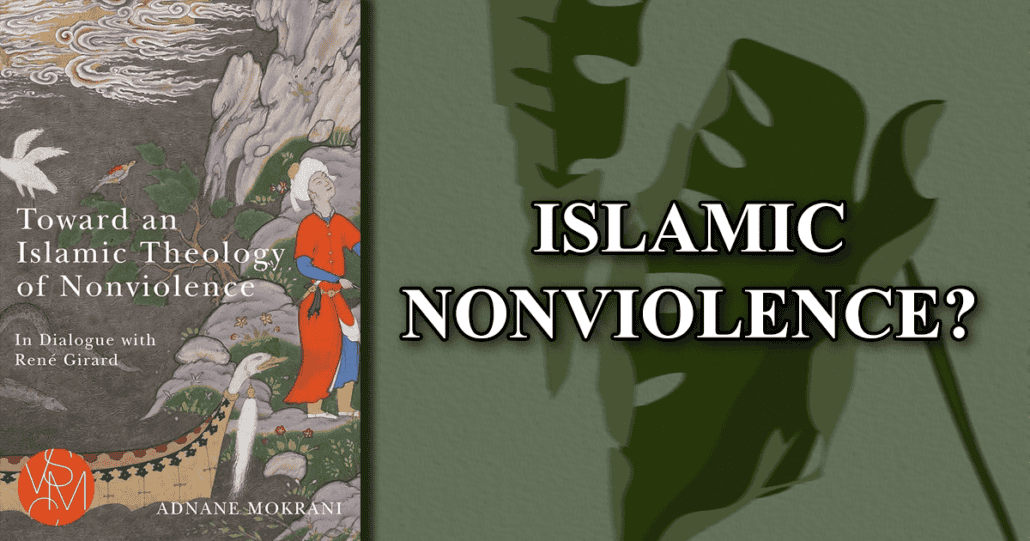
Islamic Nonviolence
Adnane Mokrani’s “Towards an Islamic Theology of Nonviolence” is perhaps the only engagement with René Girard’s anthropology written from within an Islamic framework.
In the aftermath of 9/11, Girard often suggested that militant Islam represented a possible return of sacrificial religion into history. Mokrani’s work can be read, at least in part, as a response to that suspicion. Yet the book is not merely apologetic. Rather, it is an attempt to reinterpret Islam through the anthropological and mimetic insights of Girard himself. The result is a remarkably original study that challenges simplistic assumptions about Islam while simultaneously expanding the scope of Girardian thought.
One of the book’s greatest strengths lies in Mokrani’s reading of specific passages in scripture as a counter-history to official narratives of power. He writes:
“The Scriptures have always represented a parallel ‘history,’ an unofficial narrative of the world, which is not written by the powerful and their courts, despite continuing efforts to master and reinterpret this narrative.”
This observation is profoundly illuminating. It explains why sacred texts often contain both sacrificial and anti-sacrificial strands. Scripture emerges not as a monolithic justification of power, but as a contested field in which the voices of victims and oppressors coexist in tension. In this sense, Mokrani’s reading resonates strongly with Girard’s own conviction that biblical revelation progressively unveils the innocence of the scapegoat.
Mokrani’s treatment of Islamic monotheism is especially noteworthy. He argues that tawhid, the affirmation of the oneness of God, is not merely a theological doctrine but an anthropological liberation.
“As a monotheistic religion, Islam emphasizes the importance of having God as the only and last ‘desire.’ The unification of desires is liberation from all desires, just as the adoration of the One God is liberation from any attachment and idol.”
This is a strikingly Girardian insight. Polytheism fragments desire among competing objects and powers, thereby multiplying mimetic rivalry. Monotheism, by contrast, directs desire toward a single transcendent source, reducing the centrifugal pull toward rivalry and scapegoating. Islam therefore appears not as a sacrificial religion in the archaic sense, but as a fundamentally anti-sacrificial one.
This argument becomes even more persuasive in Mokrani’s discussion of Islamic institutions. He writes:
“Even though Islam is a non-sacrificial and non-sacerdotal religion, the mosque’s position in the history of Islamic institutions confirms Girard’s theory on the religious origin of culture. The Islamic institution par excellence is the mosque, which is at the physical and symbolic center of the city, the mother of all institutions. It is an institution based on non-sacrificial prayer, like the post-Templar Jewish one. Jewish prayer has maintained a messianic sacrificial horizon, hoping to return to the priestly sacrificial form with the reconstruction of the Temple. On the other hand, Christianity has maintained the sacrificial form but with an anti-sacrificial and anti-pagan spirit, where the great Sacrifice has abolished all sacrifices. This transition from institutional centralism to institutional specialization is a well-known phenomenon in the history of religions and civilizations, accompanied by a similar transition in the field of human knowledge. Girard is not the only one to affirm the religious origin of the institutions. His criticism is rather directed to the presumptuous claim of a total break with the religious past, without preserving the ‘antibodies’ against violence produced by anti-sacrificial religions.”
This passage deserves careful attention because it demonstrates the sophistication of Mokrani’s project. He accepts Girard’s thesis that culture and institutions emerge from religion, but he rejects the reduction of religion (at least in the modern context) to primitive violence alone. The mosque, unlike the archaic temple, is not centered on sacrificial bloodshed but on communal prayer. Nevertheless, it still functions as the symbolic heart of civilization. Mokrani therefore preserves Girard’s insight into the religious origins of culture while simultaneously arguing that religions can evolve away from sacrificial structures. His comparison with Judaism and Christianity is equally nuanced. Judaism retains a messianic memory of temple sacrifice, while Christianity transforms sacrifice into an anti-sacrificial revelation through Christ. Islam, meanwhile, institutionalizes a radically non-sacerdotal form of worship. What emerges is not a simplistic hierarchy between religions, but a complex map of humanity’s gradual movement away from sacrificial violence.
This anti-sacrificial tendency also appears in Mokrani’s (quite convincing) interpretation of Islamic animal sacrifice. He argues that the ritual dimension of sacrifice in Islam is inseparable from solidarity with the poor. Rather than functioning as a scapegoating mechanism, it redistributes sustenance and communal care. In this sense, Islam represents a historical movement beyond the human sacrifices characteristic of archaic religions, and perhaps even a gradual movement away from sacrificial logic altogether.
Equally fascinating is Mokrani’s Girardian treatment of Satan. Drawing from the Qur’an and Islamic tradition, he presents Satan as a whispering presence who internalizes mimetic temptation within the human psyche. He writes:
“[Satan’s] voice is internalized, to the point that the man thinks it is the voice of his own thought and adopts it as his own will, discovering afterward that it is nothing but alienation and perdition.”
This description aligns remarkably well with Girard’s study of Satan as the invisible force driving mimetic rivalry. To a large degree, Satan does not compel externally. He often seduces internally, making borrowed desires appear as one’s own.
Mokrani’s summary of Satanic peace is particularly profound:
“The peace of Satan is false; it is only a truce between two wars, an ephemeral satisfaction that is replaced by bitterness and regret…”
Here Mokrani captures the cyclical nature of mimetic violence itself. He highlights the Islamic observation of the illusory peace brought by the single victim mechanism. He does this by citing Qur’anic passages which depict Satan’s tendency to abandon his followers. Every false peace achieved through domination, exclusion, or scapegoating eventually collapses back into conflict.
His discussion of the Antichrist figure in Islam is similarly insightful. The “Dajjal” is described as a distorted imitation of Christ:
“[The Antichrist] is called al-Masīḥ al-Dajjāl, the imposter (deceiver) Christ, or simply Dajjāl, or sometimes Masīkh, which is a play on words by replacing the letter ḥ of Masīḥ with kh, so the meaning becomes ‘disfigured,’ or ‘deformed.’”
Girard famously described Satan as the “ape of God,” an imitator whose mimetic reproduction is always distorted. Mokrani’s reading of the Dajjal as a malformed imitation of Christ fits seamlessly into this Girardian framework.
One of the book’s most penetrating sections concerns religious formalism. Drawing from Girard’s claim that Satan’s kingdom is a caricature of God’s kingdom, Mokrani critiques forms of religiosity obsessed with appearance and ritual performance. He cites a hadith warning in favor of this fact:
“There shall emerge from among you a group of people who will cause you to consider your own prayers deficient when compared to theirs, or your own fasting deficient when compared to theirs, or your own deeds deficient when compared to theirs. They will recite the Qurʾān, but it does not go beyond their throats. They exit from Islam just like an arrow passes through the body of the hunter’s prey: the hunter looks at the arrowhead and sees no evidence that it penetrated the prey; the hunter looks at the shaft and sees no evidence that it penetrated the prey; the hunter looks at the fletching and sees no evidence that it penetrated the prey; and he looks at the notch at the arrow’s end skeptically, to see whether it has any traces of blood from the prey.”
The image is quite fascinating because it exposes the danger of religion becoming pure spectacle. Mimetic rivalry can infect religion itself, transforming piety into performance and holiness into competition.
Mokrani also convincingly demonstrates that the Qur’anic narratives consistently side with the vulnerable against the powerful. He writes:
“This opposition between the Prophets, who represent the voice of God and critical conscience, on the one hand, and the crowd, and behind it al-malaʾ, the power elite, is a main feature of this literary genre.”
The prophets confront not merely individuals but entire structures of domination. The Qur’an’s recurring emphasis on arrogant elites, the “mustakbirun,” reveals a moral framework deeply suspicious of collective violence and political manipulation. This aligns closely with the biblical unveiling of scapegoating mechanisms as undertaken by the powerful elites.
Particularly striking is Mokrani’s comparison between Qur’anic narratives and the Passion of Christ:
“In the Gospel, Jesus’s Passion clearly shows the mechanism of satanic manipulation, led by religious and political leaders. Regardless of the victims’ final fate, the satanic logic, as described in the Qurʾānic stories, is the same systematic and organized violence suffered by Jesus.”
Here Mokrani identifies a shared anti-sacrificial logic between Christianity and Islam. Both traditions expose the violence of crowds manipulated by political and religious elites.
To his credit, Mokrani does not treat Girard as beyond criticism. He argues that Girard underestimates the possibility of pluralism functioning positively. According to Mokrani, pluralism can encourage “good mimetism,” a competition toward virtue rather than rivalry. This criticism is not without merit. Girard often viewed pluralism with suspicion because of its tendency to intensify mimetic conflict. Yet Mokrani’s point remains important. Healthy pluralism may indeed create conditions for mutual moral imitation rather than violence.
At the same time, Girard’s pessimism cannot easily be dismissed. In places such as India, communal tensions and religious extremism demonstrate how fragile pluralism can become under conditions of mimetic escalation. The ideal environment envisioned by Mokrani would likely require a far deeper anthropological awareness of religion itself, particularly an awareness of religion’s relationship to violence and scapegoating. Such awareness remains tragically rare, both among secular academics trapped within reductionist anti-religious assumptions and among believers attached primarily to external forms.
As already mentioned above, vast numbers of Christians and Muslims remain fixated on appearances rather than the anti-violent core of their traditions. Many Christians, for example, continue to interpret their faith through frameworks of civilizational conflict and justified violence, despite the radically anti-sacrificial revelation of Christ. Today, there are highly influential Christians who say we must bomb places simply because they are Muslim. In such a world, Girard’s reluctance to embrace an optimistic eschatology becomes understandable.
Ultimately, “Towards an Islamic Theology of Nonviolence” is a deeply important work. Mokrani succeeds not only in presenting Islam as a religion capable of profound anti-sacrificial interpretation, but also in expanding Girardian anthropology into new theological territory. Even where one disagrees with him, the seriousness and originality of his arguments demand engagement. For Christian readers influenced by Girard, this book offers a much-needed corrective to shallow understandings of Islam and opens the possibility of genuine theological dialogue grounded in a shared confrontation with violence, scapegoating, and mimetic desire.
Read more essays by Surit Dasgupta here.









Leave a Reply
Want to join the discussion?Feel free to contribute!