
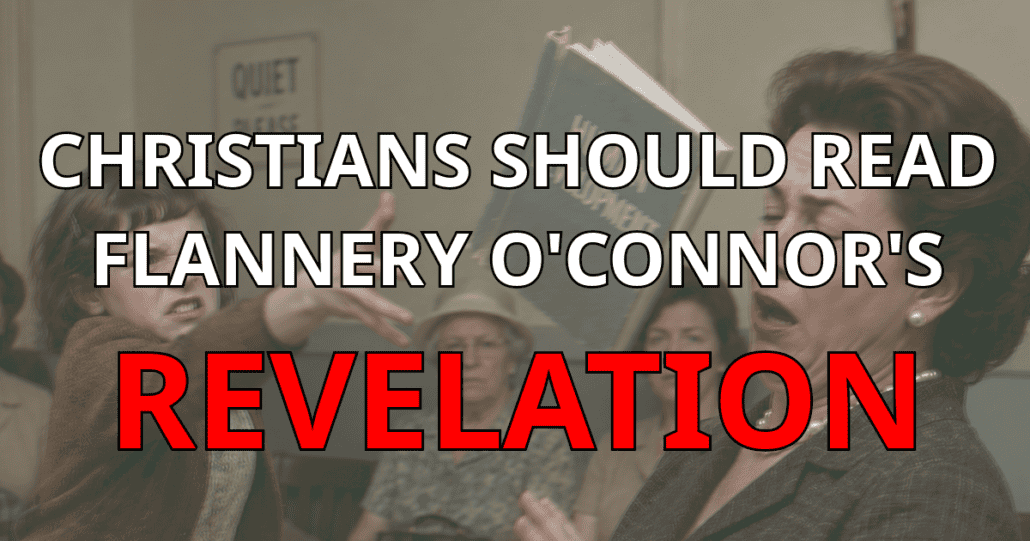
Why Christians Should Read “Revelation” By Flannery O’Connor
In the world of Flannery O’Connor’s fiction, grace rarely arrives in comfortable form; most often it arrive through humiliation, suffering, and grotesque moments in which a person’s carefully constructed understanding of himself is suddenly deconstructed and exposed as a lie. Few of her stories demonstrate this more powerfully than “Revelation,” first published in 1964, the last story O’Connor completed before her death.
Flannery O’Connor was born in Savannah, Georgia, in 1925 and spent much of her adult life in the American South. At the age of twenty-five, she was diagnosed with lupus, the same disease that had killed her father. Her illness served as a constant reminder of mortality and dependence, giving her an unusual perspective on the proud illusion of human self-sufficiency. Her characters frequently believe themselves to be strong, respectable, independent, and morally secure until some violent interruption reveals how little control they actually possess.
Ruby Turpin and the Hierarchy of Respectability
“Revelation” begins in the waiting room of a doctor’s office, where Ruby Turpin sits with her husband, Claud, while they wait for medical treatment. The room contains a small cross-section of Southern society: a pleasant woman, her self-satisfied children, a thin woman reading, and a young girl named Mary Grace who is physically unattractive and described as intellectually disabled.
Ruby appears at first to be merely a talkative Southern woman. But as she speaks, O’Connor gradually reveals that Ruby possesses an elaborate system for understanding the world. She categorizes everyone around her according to race, class, education, manners, property, and social standing. She does not merely notice differences between people. She arranges them into a hierarchy.
Girard argued that human beings understand themselves through imitation and comparison. We desire recognition, status, and belonging partly because we see others desiring them. Ruby’s identity and the resulting social hierarchy are similarly constructed and enforced through the mimetic desires of her fellow Southerners. She knows who she is because she knows who is expected to be beneath her.
Wealthy and respectable people stand above poor people. White people stand above Black people. Educated people stand above the uneducated. “Good” families stand above “white trash.” Ruby does not merely observe these distinctions, but she treats them as an almost natural order of creation, disguising this obvious segregation with the veil of a virtuous Southern lady. In other words, her “racism” or “classism” is not born out of some overt sense of conviction or even hatred; it comes primarily from social convention.
When the “white trash” woman proposes that blacks be sent back to Africa, Mrs. Turpin replies, “There’s a heap of things worse than a nigger, it’s all kinds of them just like it’s all kinds of us.” Ruby’s statement does not excuse her prejudice, but in fact, it reveals a deeper bias against those whom she calls “white trash,” as evidenced by the following paragraph:
Sometimes at night when she couldn’t go to sleep, Mrs. Turpin would occupy herself with the question of who she would have chosen to be if she couldn’t have been herself. If Jesus had said to her before he made her, “There’s only two places available for you. You can either be a nig- ger or white-trash,” what would she have said? “Please, Jesus, please,” she would have said, “just let me wait until there’s another place available,” and he would have said, “No, you have to go right now and I have only those two places so make up your mind.” She would have wiggled and squirmed and begged and pleaded but it would have been no use and finally she would have said, “All right, make me a nigger then-but that don’t mean a trashy one.” And he would have made her a neat clean respectable Negro woman, herself but black.
Mrs. Turpin’s continued inner monologue is reminescent of the Pharisee’s prayer in Luke chapter 18.
If Jesus had said, “You can be high society and have all the money vou want and be thin and svelte-like, but you can’t be a good woman with it,” she would have had to say, “Well don’t make me that then. Make me a good woman and it don’t matter what else, how fat or how ugly or how poor!” Her heart rose. He had not made her a nigger or white-trash or ugly! He had made her herself and given her a little of everything. Jesus, thank you! she said. Thank you thank you thank you! Whenever she counted her blessings she felt as buoyant as if she weighed one hundred and twenty-five pounds instead of one hundred and eighty.
Here, O’Connor brilliantly illustrates the type of “cultural Christian” that we find all too often in churches. Like a typical churchgoer who has baptized her faith with her culture rather than the other way around, Ruby believes that she is expressing gratitude for divine providence. Yet her gratitude has become a disguised form of self-exaltation and a dangerous combination of a “once saved, always saved” mindset laced with discrimination. She is thankful to God because, in her imagination, God has placed her near the top of the human hierarchy. Her theology has become inseparable from her social status. Her Christianity has become a system of reassurance.
The danger of such confidence is not simply theological. It is psychological. If Ruby already knows that she is one of the good people, then everyone else can be measured against her. The poor can be judged. Blacks can be ranked. Uneducated people can be mocked. “White trash” can be despised. Even people who are physically or mentally abnormal can be placed somewhere within her elaborate taxonomy.
The First and the Last
Ruby’s hierarchy is almost a direct inversion of one of Christ’s most persistent teachings: “the last shall be first, and the first last.” Christ identifies himself with the hungry, the naked, the imprisoned, and the socially insignificant. Ruby Turpin, however, lives according to the opposite principle. She understands the world vertically. There are people above, people below, and people somewhere in between. Her agricultural imagery makes this especially clear. She sees people almost as different species within an ordered social landscape. Even her gratitude to God is expressed through this hierarchy.
Girard helps us see why such hierarchies are so psychologically attractive. They protect people from the anxiety of uncertainty. If I can identify someone as inferior to myself, I no longer have to confront my own insecurity. The existence of someone beneath me confirms my position.
The scapegoat performs an even more important function in such a system. A community under tension can preserve its internal cohesion by directing hostility toward a person or group considered responsible for its disorder. The scapegoat becomes the bearer of everything the community wishes to exclude from itself. The poor, the racially marginalized, the deformed, the mentally disabled, and the socially unacceptable are particularly vulnerable to this process because they are already marked as different. Their difference makes them convenient targets.
Mary Grace enters the waiting room as precisely such a disturbing outsider. But O’Connor reverses the expected arrangement. The person everyone regards as grotesque becomes the one who sees through the respectable woman.
Mary Grace and the Shock of “Human Development”
In Luke chapter 1, Mary, the mother of Jesus, sings the following:
He has scattered the proud in the imagination of their hearts.
He has put down the mighty from their thrones,
And exalted the lowly.
He has filled the hungry with good things,
And the rich He has sent away empty.
These passages, among other things, were likely the inspiration for the aptly named character of Mary Grace, written by the devoutly Catholic O’Connor. After all, Mary’s Magnificat is famous for presenting, in advance, what Jesus envisions as the anti-sacrificial order of creation, where scapegoats are elevated rather than judged or persecuted.
Mary Grace’s presence in the doctor’s office is unsettling from the beginning. Her mother is embarrassed by her behavior. Ruby finds her disturbing. The girl’s eyes appear to possess an intensity that Ruby cannot understand. Then Mary Grace suddenly attacks Ruby. She throws the book Human Development at her and strikes her in the face. On the surface, the incident is absurd. Why should a mentally disabled teenage girl assault an apparently respectable middle-aged woman with a textbook? Yet the title of the book makes the incident extraordinarily significant. Human Development is precisely what Ruby lacks.
Ruby has developed socially. She has acquired property, respectability, manners, and a confident position within her community. But the encounter suggests that she has not developed spiritually. Her social development has become a substitute for moral development. Like many churchgoers, she is nowhere near Jesus’s understanding of creation. The book is therefore almost an instrument of judgment.
Mary Grace does not deliver an elaborate theological sermon. She does something much more powerful. She violently interrupts Ruby’s self-satisfied understanding of herself. The encounter destabilizes the mimetic system through which Ruby understands the world. Ruby expects Mary Grace to occupy the role of the inferior, the strange, the defective person who confirms Ruby’s own normality. Instead, Mary Grace becomes the one person in the room who refuses to participate in Ruby’s hierarchy.
Grace enters through the person whom respectable society has already classified as insignificant. “Go back to hell where you came from, you old wart hog,” Mary Grace whispers after throwing the book. Mary Grace is subsequently hospitalized, and Ruby is left shaken by the encounter. But she does not immediately understand it. She cannot. Her entire moral vocabulary has been constructed around the assumption that she is one of the people who understands things correctly.
The Violence of Revelation
The title “Revelation” refers not merely to Ruby learning something new. It refers to the unveiling of something that was already there. Ruby’s deepest problem has always been visible to the reader. She is proud, judgmental, obsessed with social distinctions, and confident in her own righteousness.
Grace first makes Ruby see that she is not as good as she thought she was. In fact, Grace slaps the image of a warthog on Ruby—an image that Mrs. Turpin probably despises the most. This is why O’Connor’s grace so often appears violent.
The revelation comes through an abrupt short-circuiting of Ruby’s worldview because her false self is deeply ingrained. Her identity and hierarchy depend upon continually pushing certain people downward. The walls of her identity have been constructed from distinctions between respectable and disreputable, rich and poor, white and Black, educated and uneducated, normal and grotesque. Mary Grace’s assault cracks those walls.
The irony is that Ruby initially experiences herself as the victim. She has been attacked by the person she regards as socially and intellectually inferior. But from the perspective of the story, the assault has also made Ruby the object of a revelation. She is forced into the position of the judged. The person who thought she understood everyone else suddenly discovers that she does not understand herself.
Ruby’s Railing Against God
The climax of the story occurs after Ruby has returned to her farm. There, overwhelmed by the day’s events, she turns toward God in anger. She points a hose at a pack of pigs and starts blindly attacking them with the powerful stream; it is as if she is unconsciously trying to empty her demons into her own Gadarene hogs. She asks why she has been subjected to such an experience. She has worked hard. She has behaved properly. She has fulfilled the expectations of respectable society. Yet God has allowed a grotesque girl to insult her and destroy her confidence.
“How am I a hog?” she demanded. “Exactly how am I like them? There was plenty of trash there. It didn’t have to be me. If you like trash better, go get yourself some trash then,” she railed. “You could have made me trash. Or a nigger. If trash is what you wanted why didn’t you make me trash?”
Here, Ruby is asking God why the world does not operate according to the hierarchy she believes He established. This is the moment when her religious faith is placed under genuine pressure. She has believed that God’s order and her social order are essentially the same thing. Now she discovers that they are not.
And then she sees the vision. The evening sky is filled with a strange procession—one led by “white trash,” of all people.
…A vast horde of souls were rumbling toward heaven. There were whole companies of white-trash. clean for the first time in their lives, and bands of black niggers in white robes, and battalions of freaks and lunatics shouting and clapping and leaping like frogs. And bringing up the end of the procession was a tribe of people whom she recognized at once as those who, like herself and Claud, had always had a little of everything and the God-given wit to use it right.
Ruby’s entire hierarchy is overturned.
The people whom human beings reject and marginalize are precisely those whom the divine perspective refuses to treat as disposable. The community may designate someone as inferior, impure, grotesque, or dangerous, but the divine gaze exposes the arbitrariness of the designation.
The scapegoat is not actually what the community says he is. The victim is innocent of the symbolic pollution assigned to him. Once the scapegoat mechanism is exposed, the community’s supposed righteousness becomes much harder to sustain.
Can Ruby Be Saved?
The vision does not announce that Ruby is damned. Nor does it tell us that she has immediately become a saint. Instead, it leaves her at the threshold of transformation. This is important because O’Connor’s understanding of grace is not sentimental. Grace does not mean that God simply tells people that they are already good enough. Grace often begins with the destruction of the illusion that they are good enough.
The revelation is not that Ruby has discovered a new piece of information about God. The revelation is that she has discovered that God is not the projection of her own social prejudices.
Christ does not establish human worth according to worldly hierarchy. He identifies Himself with those whom the respectable world rejects. The Kingdom of God therefore threatens every system that depends upon human beings needing someone beneath them in order to feel secure.
This is why the Christian message can be so offensive to the respectable person. The scandal of the Gospel is not merely that sinners can be forgiven. It is that the person I regard as beneath me may be closer to God than I am. Ruby’s encounter with Mary Grace makes this scandal personal.
Read more essays by Surit Dasgupta here.








Leave a Reply
Want to join the discussion?Feel free to contribute!