
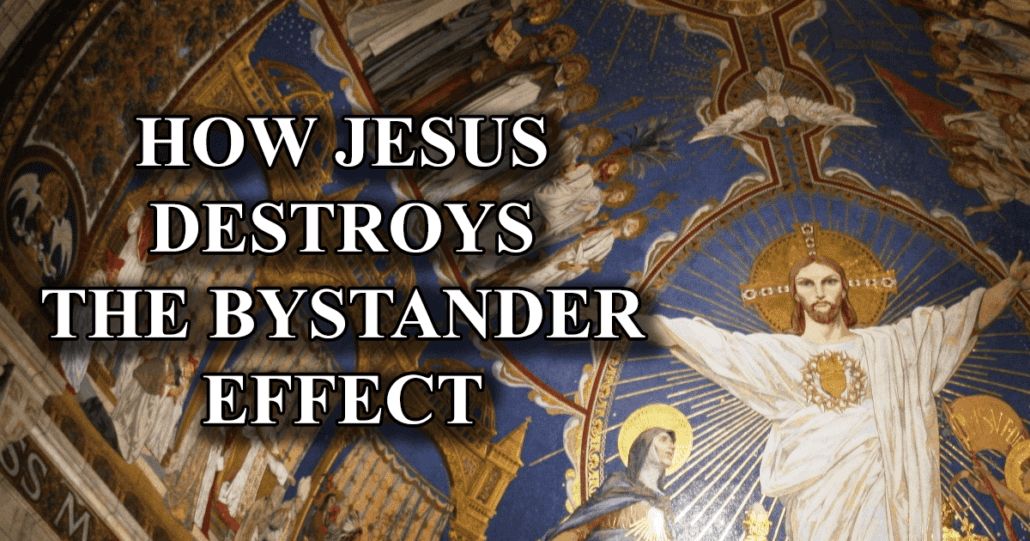
How Christ Destroys the Bystander Effect
Why are modern people so desensitized to violence? Some insist that atrocities such as the Holocaust could never occur again in the age of the internet and social media, because instant communication would expose evil before it could fully manifest itself. Yet the international reaction to the suffering and destruction in Gaza has revealed the weakness of this assumption. We now possess unprecedented access to images of human agony, and yet this visibility has not necessarily produced compassion. Instead, the endless circulation of violent imagery often produces exhaustion, indifference, tribalism, or even voyeuristic fascination.
This desensitization to violence exists not only among materialists or nihilists, but even among Christians. Many Christians have become far too comfortable with violence inflicted upon their neighbors whenever that violence is carried out under the banner of legitimacy, national security, political necessity, or ideological righteousness. Violence is often excused so long as it is performed by governments, militaries, or institutions regarded as respectable.
For Christians, however, violence should remain a horrifying fact of life, something alien to the Kingdom of God. It should never become ordinary. Yet many Christians justify violence by appealing to the fallen nature of humanity. Violence, they argue, is a “necessary evil.” Since evil exists in the world, violence must be used to restrain it. This line of reasoning reveals how little many Christians believe the Gospel truly has to say about humanity’s violent nature.
The Gospel, contrary to popular opinion, has everything to say about violence. In fact, violence is the primary target of the central drama of Christ’s earthly life: the Passion narrative. Yet the Gospel does not approach violence in the way the world does. Christ exposes violence at its spiritual root.
There are two dominant ways the world understands violence.
The first is the individualistic way. Here violence is viewed selfishly. Evil is only truly recognized as evil when it happens to oneself. The suffering of others becomes distant, abstract, or irrelevant. The result is what we commonly call the bystander effect. When violence occurs nearby, people often do not intervene. Instead, they record the event on their phones, turning another person’s suffering into consumable spectacle.
This happens because modern people increasingly think of themselves as the protagonists of reality while viewing everyone else as background characters. The language of video games captures this mentality well through the term “NPC,” or non-playable character. Others exist merely as scenery within one’s personal narrative. Their suffering does not penetrate the heart because they are not perceived as fully real.
Scripture radically overturns this way of seeing the world.
After murdering his brother Abel, Cain responds to God with the question: “Am I my brother’s keeper?” (Genesis 4:9). This question lies at the foundation of fallen human civilization. Cain wishes to deny responsibility for the other person. He wishes to separate his own life from his brother’s suffering. Yet the entire Biblical narrative answers Cain with a resounding yes. Humanity is indeed responsible for one another.
Christ intensifies this truth. “Thou shalt love thy neighbour as thyself” (Mark 12:31). The command does not merely ask for politeness or sympathy. It destroys the illusion that the self exists independently of others. To love another “as thyself” means that the boundary between self-concern and concern for the neighbor is spiritually dissolved.
Likewise, Christ says: “For God so loved the world, that He gave His only begotten Son” (John 3:16). God does not stand at a distance from human suffering. He enters into it. The Incarnation itself is the ultimate refutation of detachment. God becomes vulnerable to humanity’s violence rather than remaining a passive observer.
This same truth appears in the parable of the Good Samaritan (Luke 10:25-37). The priest and the Levite pass by the wounded man because involvement would inconvenience them. They preserve their own safety, ritual purity, and social comfort. The Samaritan, however, interrupts his own journey for the sake of the suffering stranger. Compassion here is not emotion alone. It is participation in another person’s pain.
Christ consistently breaks the logic of indifference. He touches lepers, eats with sinners, weeps at Lazarus’s tomb (John 11:35), and identifies Himself with the hungry, imprisoned, and abandoned: “Inasmuch as ye have done it unto one of the least of these My brethren, ye have done it unto Me” (Matthew 25:40). Violence and neglect toward another human being become violence and neglect toward Christ Himself.
The second way the world understands violence is collective rather than individual. Here violence is normalized and treated as necessary for the preservation of society. This violence is usually carried out not by isolated individuals but by crowds, mobs, institutions, armies, or ideological movements. It appears in ethnic hatred, religious persecution, nationalism, class warfare, and sexism. The defining feature of collective violence is the disappearance of personal responsibility. The individual dissolves into the crowd and therefore no longer feels morally accountable.
Christ overturns this mindset as well.
When the Pharisees bring before Him the woman accused of adultery, they prepare to stone her according to the law. Christ responds: “He that is without sin among you, let him first cast a stone at her” (John 8:7). One by one, the accusers depart.
This moment is revolutionary because Christ dismantles the psychology of mob violence. Crowds survive by convincing individuals that responsibility belongs to everyone and therefore to no one. Christ forces each person standing there to confront his own soul individually. Before condemning another, each person must first confront his own violence, hypocrisy, and sinfulness.
The crowd disintegrates the moment self-reflection begins.
This transformation is beautifully summarized in Fyodor Dostoevsky’s “The Brothers Karamazov” through the words of Elder Zosima:
“There is only one way to salvation, and that is to make yourself responsible for all men’s sins. As soon as you make yourself responsible in all sincerity for everything and for everyone, you will see at once that you are in fact to blame for everyone and for all things.”
Zosima’s words strike directly at the heart of humanity’s attempt to hide within collectives. Human beings constantly seek refuge in abstractions such as nation, race, party, ideology, religion, or crowd. Within these collectives, people excuse acts they would never commit alone. Responsibility becomes diffused across the mass, and conscience is numbed.
Zosima proposes the exact opposite spiritual movement. Salvation begins not by transferring guilt outward, but by drawing responsibility inward. To make oneself “responsible for all” does not mean literally causing every evil act. Rather, it means recognizing one’s participation in the spiritual condition that makes violence possible. Hatred, pride, indifference, resentment, envy, tribalism, and self-righteousness all contribute to the atmosphere in which violence flourishes.
This is why Christ continually turns humanity away from accusation and toward repentance. The world survives through scapegoating. Every society seeks someone upon whom guilt can be unloaded. The foreigner, the heretic, the criminal, the enemy nation, the political opponent, the racial other, or the social outcast becomes the bearer of collective anxiety and rage.
The Passion of Christ exposes this mechanism completely.
The crucifixion is the moment in which two kingdoms stand opposed to one another: the kingdom of the world founded upon violence, and the Kingdom of God founded upon self-giving love.
The logic of worldly power is articulated by Caiaphas when he declares: “It is expedient for us, that one man should die for the people, and that the whole nation perish not” (John 11:50). This statement reveals the underlying logic of nearly all political violence throughout history. Peace is supposedly achieved through sacrifice. Order is maintained through exclusion. Unity is created through the destruction of a scapegoat.
This logic appears endlessly throughout human civilization. Entire peoples are demonized for the sake of national cohesion. Wars are justified in the name of security. Executions are carried out for the supposed protection of society. The crowd convinces itself that violence is regrettable but necessary.
Christ completely destroys this justification.
Because Christ is innocent, sinless, and wholly good, His murder reveals the lie hidden within sacrificial violence. If humanity can condemn and murder the Son of God while believing itself righteous, then violence can no longer claim moral legitimacy simply because it is socially approved.
The Cross exposes humanity rather than merely condemning it.
This is why Christ refuses retaliation. Though mocked, tortured, abandoned, and executed, He does not answer violence with violence. Instead He prays: “Father, forgive them; for they know not what they do” (Luke 23:34). Divine love reveals itself not through domination but through forgiveness.
This is utterly contrary to the logic of fallen humanity. Human beings believe evil can only be defeated through greater force. Yet Christ refuses to establish His Kingdom through coercion or bloodshed. He conquers violence precisely by enduring it without reproducing it.
The crucifixion therefore becomes the great unveiling of history. Ancient myths often concealed the innocence of victims. Violence was hidden beneath sacred symbols, heroic narratives, or divine justifications. The victim was portrayed as deserving death, while the community performing the killing appeared righteous and unified.
The Gospel reverses this entirely.
For the first time in religious literature, the victim is shown to be innocent while the crowd is shown to be spiritually blind. The Gospels expose the fear, cowardice, political calculation, mob psychology, and moral self-deception behind collective murder. Peter denies Christ out of fear. Pilate abandons justice for political convenience. The crowd cries “Crucify Him!” in a frenzy of collective passion.
The murder is no longer mythologized. It is revealed plainly for what it is.
Yet humanity did not fully repent after this revelation.
Instead, the modern world became what might be called Christ-haunted. The moral exposure brought about by Christianity permanently transformed human consciousness, but humanity increasingly refused the spiritual transformation demanded by that revelation.
As a result, modernity lives in a strange contradiction. Violence can no longer fully hide behind myth or sacred symbolism, yet humanity continues to commit violence anyway. The internet now gives us endless access to images of suffering, death, humiliation, war, and cruelty. There is now almost no barrier between the violent act and the passive observer.
Yet this constant exposure has not necessarily deepened compassion. Instead, it often produces numbness.
Human beings endlessly scroll past images of bombed cities, starving children, lynchings, executions, police brutality, humiliation, and public cruelty. Violence becomes part of the background noise of daily existence. The horror that should accompany the destruction of human life slowly disappears. Violence becomes mundane.
This mundaneness exists because humanity has allowed itself to witness Christ’s revelation intellectually without permitting it to penetrate the heart spiritually.
Sadhu Sundar Singh once used the image of a rock lying in a river. Though water flows continuously around it for years, the inside of the rock remains perfectly dry because the water never penetrates it. In the same way, many people surround themselves with Christian language, symbols, rituals, and even Scripture while remaining inwardly untouched by the spirit of Christ.
The modern world is saturated with Christian moral imagery. Concepts such as compassion, human dignity, equality, mercy, care for victims, and concern for the oppressed all emerge historically from the moral revolution initiated by Christianity. Yet despite being immersed in these ideas, humanity often remains spiritually hardened.
Christ has flowed around civilization for centuries, yet the inner stone remains dry.
This is why even Christians can become desensitized to violence. They may profess belief in Christ while emotionally participating in the same cycles of hatred, scapegoating, nationalism, tribalism, vengeance, and cruelty that crucified Him in the first place.
The Cross is not merely an event to admire from a distance. It is a revelation demanding transformation. Christ calls humanity not only to condemn violence in theory, but to recognize its roots within the human heart itself.
Had humanity truly allowed Christ to penetrate its heart, the world would be radically different. Human beings would no longer seek salvation through enemies, scapegoats, or necessary evils. Nations would no longer define themselves through hostility toward others. Crowds would no longer intoxicate themselves with righteous fury. The suffering neighbor would no longer be treated as disposable or unreal.
The Kingdom of God stands opposed to every form of violence rooted in domination, hatred, and sacrificial logic.
And yet the Christian hope remains that violence does not have the final word. The Resurrection of Christ reveals that love is stronger than death itself. The Cross exposes the truth about humanity, but the Resurrection reveals the destiny God desires for creation.
A world transformed by Christ would not merely be less violent. It would be reconciled. It would become a world prepared for the return of the risen Christ, in whom every barrier between God and humanity, and between human beings themselves, is finally overcome.
Read more essays by Surit Dasgupta.









Leave a Reply
Want to join the discussion?Feel free to contribute!